EIFS Repair Services in Central Indiana
EIFS Repair Starts With Finding What Failed
Indiana Wall Systems repairs residential and commercial EIFS across Central Indiana, including cracks, failed sealant joints, woodpecker holes, and moisture-related damage.
The repair scope depends on what failed, how far the damage extends, and the condition of the surrounding wall. Visible damage may be limited to the finish or may require a closer look at the details and materials beneath it.
Not sure how serious the damage?
Have the wall condition reviewed before deciding on a repair. The scope should account for the visible damage, surrounding materials, and any signs that a closer inspection is needed.
EIFS Problems Usually Begin at the Details
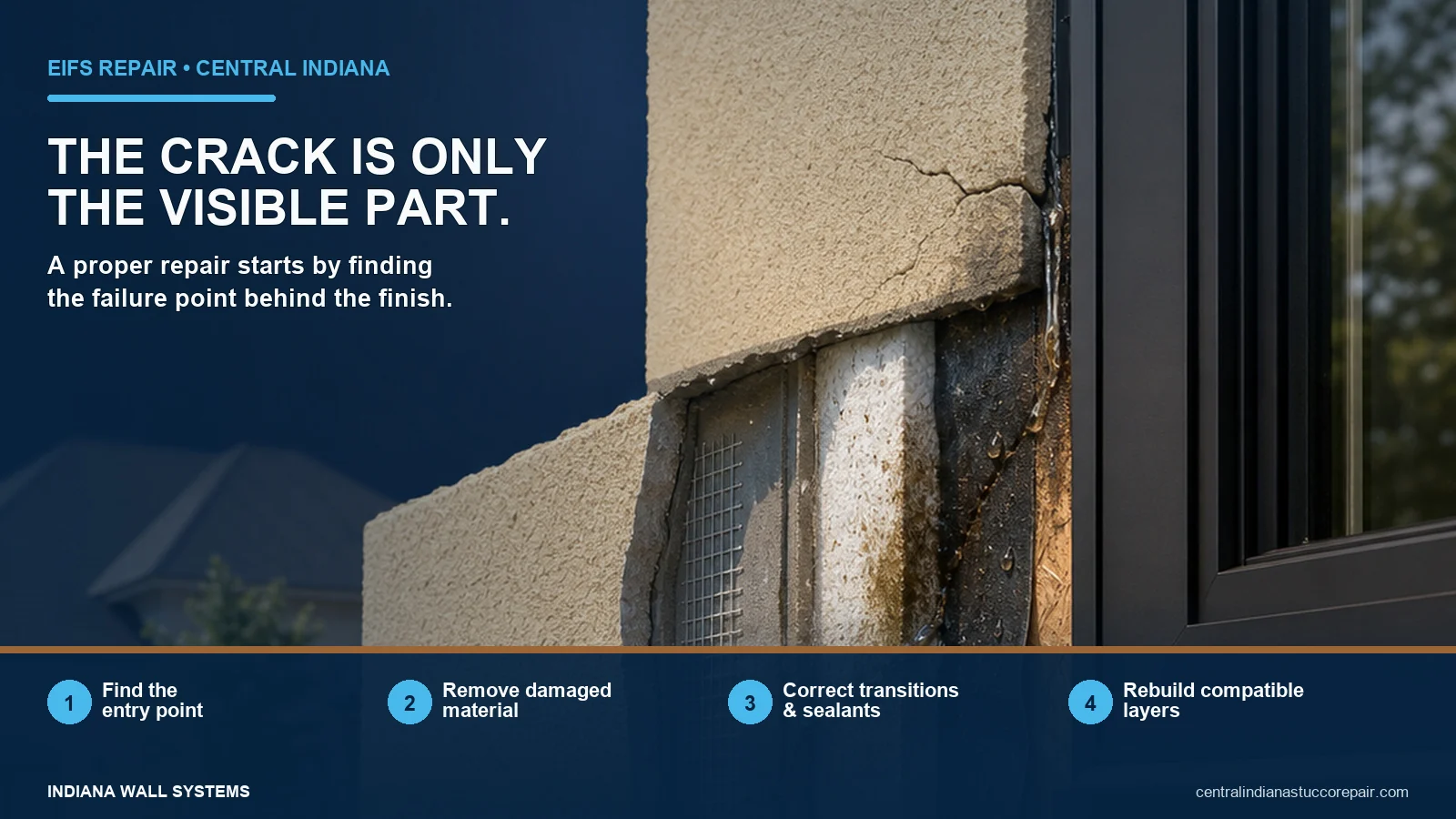
EIFS is a layered exterior wall system. Most problems do not start in the middle of an uninterrupted wall. They start at transitions, openings, and termination points, where water has a way in if the detailing is wrong or has aged past its service life.
The details that fail most often include window and door perimeters, roof-to-wall intersections, chimneys and dormers, accent bands and ledges, sealant joints, wall penetrations such as vents and hose bibs, and lower terminations near grade. Areas exposed to impact are also common trouble spots, along with transitions where EIFS meets brick, stone, roofing, or other exterior materials.
The reason this matters for repair is simple: surface work alone may fail if the source of the water entry, the movement, or the poor detail is left unchanged. Filling a crack does nothing for a window perimeter that is still letting water behind the finish. If the visible condition suggests a detail failure, the detail is part of the repair. Our EIFS inspection services page explains how those failure points are evaluated when the condition warrants a closer look before repair.
Common EIFS Repairs Indiana Wall Systems Performs
Indiana Wall Systems handles EIFS repairs based on the wall condition, the failure point, and the materials needed to rebuild the damaged area correctly. The right repair depends on what the wall is showing and what is found around and beneath the visible damage. These are the repair types that come up most often across Central Indiana homes and commercial buildings. Not every project needs every one of them.
Crack Repair
Cracks are read by location and pattern first. A hairline crack at a window corner is treated differently than surface crazing across an open field of wall, because the corner crack often signals movement or a detail issue.
Delamination Repair
Finish or base coat separating from the layer beneath it needs the loose material removed and rebuilt, not coated over.
Water-Damaged EIFS Sections
Where moisture has gotten behind the finish, the affected area is opened so the condition can be checked and the damaged layers rebuilt.
Soft or Damaged Substrate Areas
Soft spots can indicate damage behind the finish. The substrate is evaluated before the area is closed back up.
Window and Door Perimeter Repair
The most common entry points on an EIFS wall. Repairs here often combine finish work with sealant and detail correction.
Chimney and Roofline EIFS Repair
Chimneys, dormers, and roof-to-wall areas take a lot of water. Repairs address both the damage and the detail that let water reach it.
Failed Sealant and Joint Repair
Aged or separated sealant is replaced with material compatible with EIFS, not general-purpose caulk.
Impact and Puncture Damage
Dents, breaks, and holes from impact, fixtures, or fasteners are rebuilt with compatible materials after the surrounding area is checked.
Woodpecker Hole Repair
Small openings are closed properly after the material around them is inspected, since damage can extend past what is visible.
Accent Band and Trim Correction
Flat or undercut ledges that hold water are reshaped so they shed it.
Insulation, Mesh, and Base-Coat Repair
When layers are damaged, the insulation board, reinforcement mesh, and base coat are rebuilt in sequence before the finish goes back on.
Texture, Finish, and Coating Work
New finish is worked to blend with the existing wall as closely as the aged surface allows, and coating is used where it fits the system rather than applied automatically.
Restoration and Prior-Repair Correction
Older walls with several tired spots may be renewed in sections rather than patched repeatedly, and a patch that reopened is checked to understand why before it is rebuilt.
Warning Signs Worth Checking
These signs warrant a closer look, but they do not establish how far damage extends. Evaluation may include the surrounding details, possible water paths, movement, prior repairs, and the condition beneath the finish.
A crack that returns warrants a closer look at movement, repair materials, and the surrounding details.
Dark streaks may point to runoff or water entry from a detail above.
Unusual softness or flexibility should be evaluated with other signs; touch alone does not establish the cause.
Separated or hardened joints leave an open path for water at openings and transitions.
Finish coming away from the layer beneath it should be checked, not coated over.
Woodpecker holes and impact breaks can allow water to reach the insulation and substrate.
A repaired area that looks wet, cracked, or off from the wall around it deserves a second look.
Recurring leaks warrant a closer look at the entry point and surrounding flashing, sealants, and drainage details.
Cosmetic, Detail Failure, Moisture, or Substrate Damage
EIFS repair may involve surface work, sealant or detail correction, a localized rebuild, or a larger restoration scope. The visible size of a crack, stain, or hole does not determine which approach fits the wall.
Staining should be treated as cosmetic only after its cause and the wall condition have been evaluated. Caulking and sealant work may be part of a repair, while flashing, drainage, or damaged substrate may also need attention.
What Type of EIFS Problem Is This?
The visible size of a crack, stain, or hole does not set the repair scope. What is found around and beneath it does.
Surface or Cosmetic Damage
Clues:
Minor finish wear, small chips, light surface marks with sound layers underneath.
May need: A check that the layers below are intact, then localized finish and texture work.
Sealant or Detail Failure
Clues:
Separated caulk, open joints at windows, water-holding ledges, roof-wall staining.
Should be checked: Flashing, slope, and drainage, since sealant alone may not stop the leak.
Moisture or Substrate Damage
Clues:
Soft or spongy areas, persistent staining, recurring interior leaks near a wall.
Can require: Opening the area to inspect the substrate and rebuild damaged layers.
Larger Restoration or Replacement
Clues:
Repeated failures, several repair zones, widespread moisture or substrate damage.
May justify: Section renewal or replacement when isolated patches no longer make sense.
This is general guidance, not a diagnosis of any specific wall. The correct scope depends on the condition beneath and around the visible area.
Repair, Restoration, or Replacement?
Once the wall condition is understood, most projects sort into one of three paths.
Focused repair fits isolated damage with sound surrounding material. The trouble is contained, the wall around it is doing its job, and a targeted fix restores the area.
Restoration fits walls with several repair areas, detail corrections, sealant replacement, surface renewal, or broader coating work. The system is still fundamentally sound, but it needs more than a single patch to get it back to a clean, weather-protective condition.
Replacement fits extensive substrate damage, widespread moisture problems, or wall areas that cannot reasonably be preserved through isolated patches.
The condition of the surrounding wall often matters as much as the visible size of the crack, stain, or hole. A small hole in a wall that is otherwise sound is a small repair. The same hole in a wall with soft substrate on either side of it is a different conversation. Our guide on EIFS repair versus full replacement walks through how that decision is weighed.
What a Proper EIFS Repair May Include
A proper EIFS repair may involve surface work, detail correction, material replacement, sealant work, coating, or a deeper rebuild depending on what failed. A repair scope is built to match the wall, so no two are identical. Depending on the condition, the work may include:
- Reviewing the visible damage and the surrounding wall conditions
- Identifying likely sources of water entry, movement, impact, or material failure
- Determining whether additional inspection or moisture evaluation is needed
- Removing loose, deteriorated, or damaged EIFS
- Checking the substrate and adjacent materials
- Correcting failed flashing, sealants, slopes, transitions, or penetrations when they are part of the scope
- Replacing damaged insulation where needed
- Rebuilding the base coat and reinforcement mesh
- Applying a compatible finish texture
- Completing coating or sealant work when required
- Reviewing the finished area and discussing future maintenance or monitoring
Not every project includes destructive testing, invasive moisture testing, removal of EIFS, thermal imaging, or laboratory testing. When visible conditions suggest hidden moisture or substrate damage, additional inspection may be recommended before the final repair scope is set. When the visible condition is contained and the surrounding wall is sound, the repair can move ahead without pulling the wall apart.
The Indiana Wall Systems Five-Step EIFS Repair Process
Indiana Wall Systems uses a repair process built around evaluation first, then compatible repair work based on what the wall actually needs.
Review the Visible Conditions
Walk the wall and note the damage along with the surrounding condition.
Identify Likely Failure Points
Read the details and decide whether a closer inspection is warranted.
Define the Repair Scope
Explain the recommended work and what it is meant to correct.
Complete Compatible Repairs
Rebuild with EIFS, sealant, coating, or detail work matched to the system.
Review the Finished Work
Check the completed area and discuss maintenance or monitoring.
Some EIFS repairs can be completed during cold weather when the work area, substrate, and materials can be kept within manufacturer requirements. When conditions call for it, the work area may be tented and heated so those requirements are met while the repair is completed.
Why Some EIFS Repairs Fail Again
A repair that reopens is frustrating and expensive, and the reasons are usually practical. Common ones include:
- Repairing the surface without correcting where water is getting in
- Covering damp, weak, or soft substrate instead of addressing it
- Using patching materials that are not compatible with EIFS
- Not enough reinforcement mesh, or poor mesh overlap
- Treating an active, moving joint like a fixed crack
- Leaving failed flashing or drainage details unchanged
- Using general-purpose caulk where a compatible EIFS sealant is needed
- Painting over an area without accounting for texture and existing coatings
- Making the patch too small to rebuild the damaged area properly
- Closing a hole without checking the material around it
- Repeating a prior repair without figuring out why it reopened
Our water damage repair guide explains how hidden moisture can contribute to repeat failures.
Texture, Color, and Coating Expectations
Honest expectations matter here, because this is where a lot of repairs disappoint people. New material placed next to an older EIFS finish may not disappear completely, and any contractor who promises an invisible repair is overselling.
Several factors affect how closely a repair blends: the age of the existing finish, sun exposure, dirt and staining, previous coatings, texture depth, finish type, color fading, the size of the repaired area, its location on the wall, and how light and shadow fall across the texture. A repair on a shaded lower wall reads differently than one high on a sunlit gable.
Coatings add another wrinkle. General-purpose paint can fill some of the texture pores, reduce the texture definition, and create a visible difference between coated and uncoated EIFS, even when the color match is good. In some situations, coating a larger wall section produces a more uniform result than coating only the patch. That tradeoff is discussed before the work, not discovered after it.
The aim is to correct the damaged area and blend the new finish as closely as the existing surface allows. Our article on how contractors match EIFS texture and color after a repair explains what goes into that match and where the honest limits are.
Residential EIFS Repair
Residential EIFS repair often involves areas where water, movement, impact, or roofline details create visible damage on homes. On homes, EIFS repair shows up on chimneys, gables, dormers, windows and door areas, exterior walls, additions, and roofline transitions. It also covers woodpecker holes, impact damage, localized water damage, architectural trim, and repairs around remodeled areas where new work ties into existing EIFS.
The repair scope on a home depends on what is found beneath and around the visible damage. A crack at a window corner might be a focused repair, or it might be the visible edge of a detail that has been letting water in for seasons. The only way to know is to look. Our residential EIFS services page covers the full range of home exterior work in more detail.
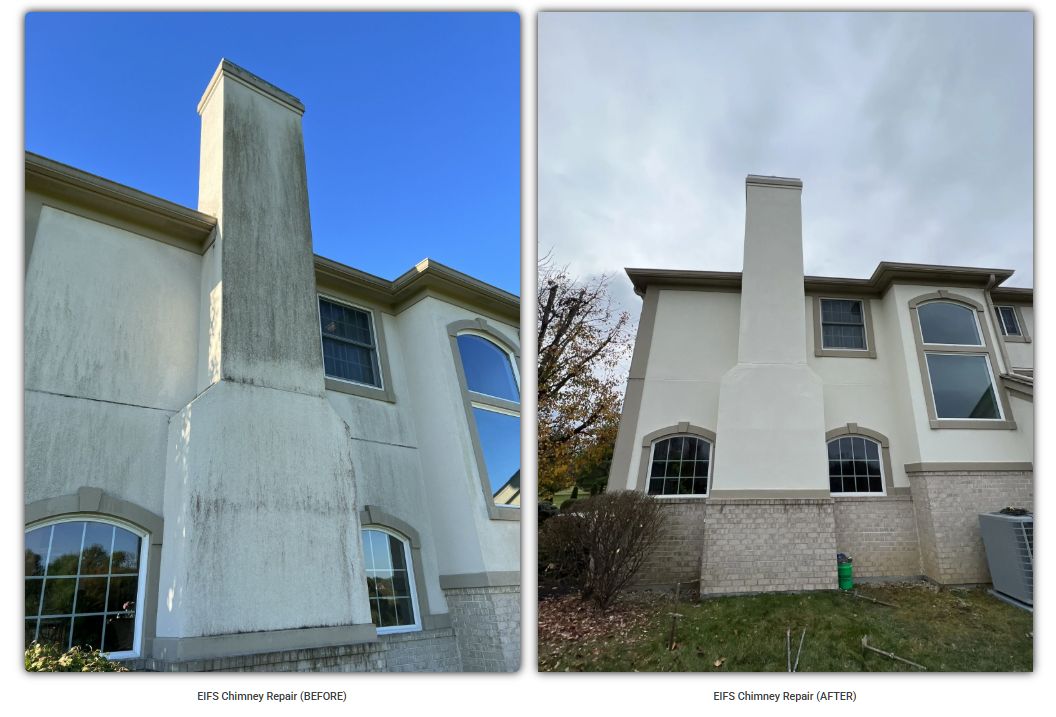
Chimneys are a good example of why detail matters. They collect water from several directions, and the repair often has to address the cap, the flashing, and the finish together rather than just the visible crack or stain.
Commercial EIFS Repair
Commercial EIFS repair often involves more than fixing the wall surface because access, tenants, operating hours, safety, staging, and building use all affect the repair plan. On commercial buildings, EIFS repair comes up on retail centers, storefronts, offices, churches, schools, hotels, managed properties, and multi-unit buildings. It also covers commercial wall sections, signage and penetration areas, high-traffic zones, and impact-prone areas near entrances and loading points.
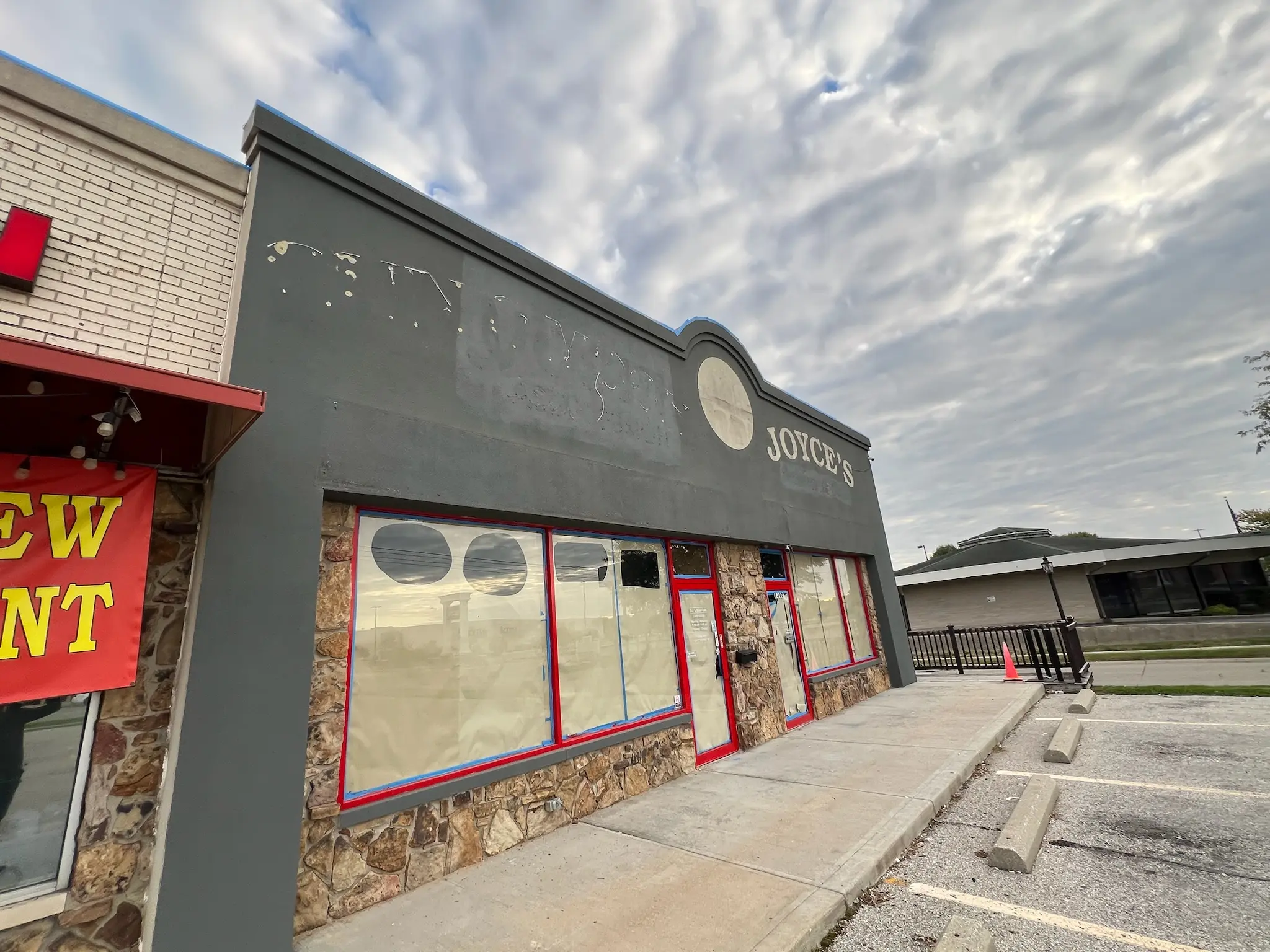
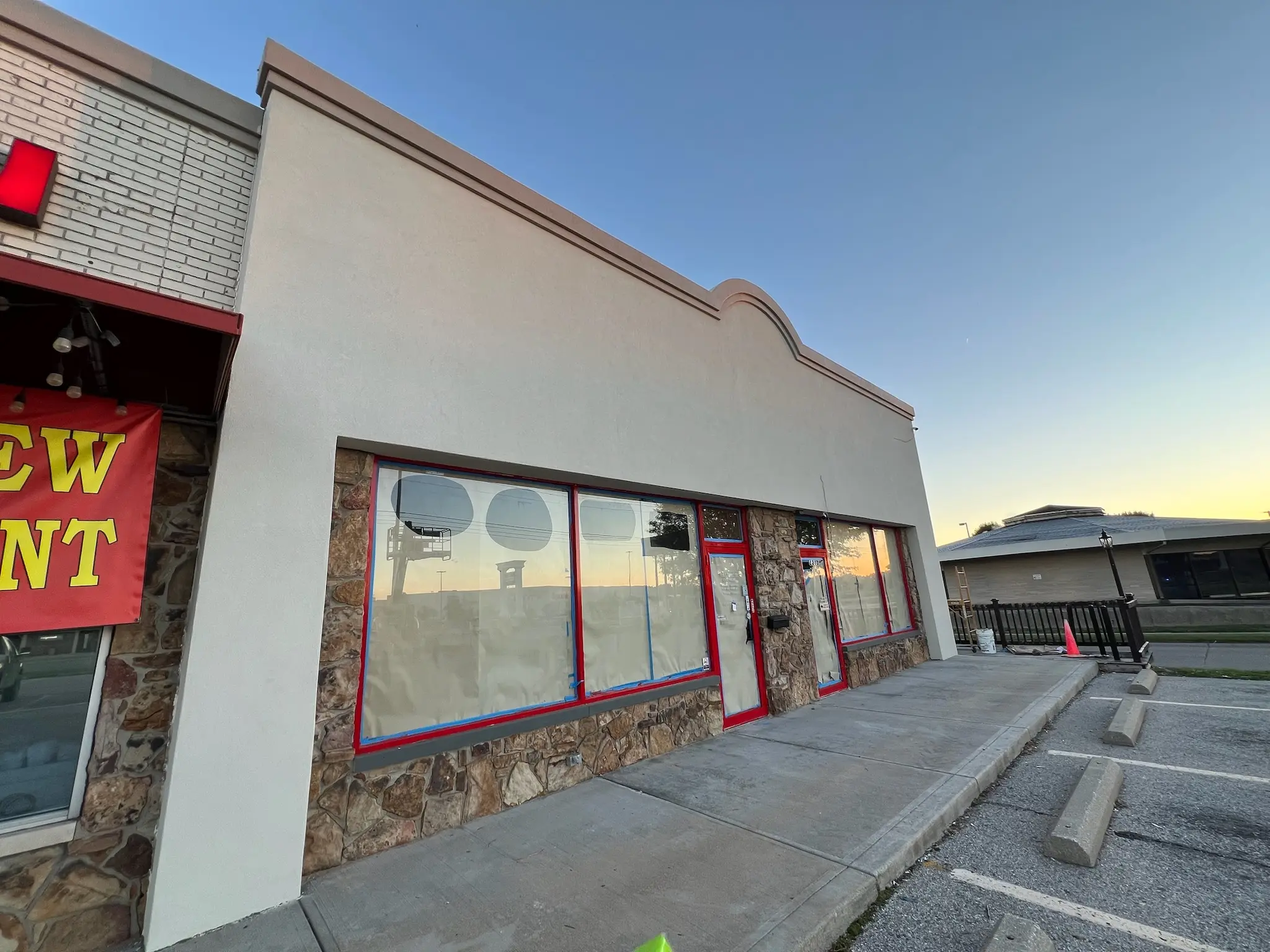
Commercial repair scopes have to account for more than the wall itself. Building access, tenants, operating hours, customer entrances, staging, safety, phased work, protecting adjacent surfaces, and coordinating around active operations all shape how the project runs. Disruption cannot always be eliminated, but it can be planned around. Our commercial EIFS services page covers how larger projects are scoped and sequenced.
Woodpecker Holes, Impact Damage, and Other Openings
Small openings should not be left exposed. A woodpecker hole, an impact break, or a puncture from a fixture or fastener can let water reach the insulation and substrate behind the finish, and the damage around the opening may extend past what shows on the surface. Repeated small patches also tend to become visually obvious over time. The right approach is to check the material surrounding the opening before it is closed, then rebuild the area with compatible EIFS materials rather than smearing filler over the hole. Impact damage from equipment, ladders, and mounted fixtures raises the same concerns and is handled the same way.
Indiana Wall Systems does not make wildlife-control promises. The focus is on closing the opening correctly and rebuilding the damaged material so the wall sheds water again. Our article on the impact of woodpeckers on EIFS covers why these openings matter and why closing them properly is worth doing.
Central Indiana Service Area
Providing EIFS repairs for clients across Central Indiana, including Indianapolis, Carmel, Fishers, Zionsville, The Village of WestClay, Greenwood, Bloomington, Columbus, and nearby communities. Selected project work outside the immediate area is considered when the scope makes sense.
The same warning signs show up throughout the region, but the right approach can vary with the age of the wall, its exposure, and how it was originally detailed. A 1990s synthetic stucco home with original sealants is a different starting point than a recent building with modern drainage EIFS.
Why Hire Indiana Wall Systems for EIFS Repair?
EIFS repair is not the same as general stucco patching. A crack, stain, soft area, open joint, or woodpecker hole may look like a surface problem, but the real issue can involve failed detailing, moisture entry, movement, damaged substrate, or materials that were not compatible with the existing wall system.
Indiana Wall Systems repairs EIFS by looking at what failed first. The repair scope is based on the visible damage, the surrounding wall condition, the likely source of the problem, and the materials needed to rebuild the area correctly.
That matters because a surface patch may look better for a while and still fail again if the water path, joint movement, failed sealant, soft substrate, or poor detail is left unchanged.
Indiana Wall Systems is a fit for property owners who want the repair handled as part of a wall system, not just filled, caulked, or painted over.
EIFS Systems, Materials, and Manufacturer Requirements
EIFS repairs should match the existing wall system and its material, detailing, and curing requirements. The work may involve compatible sealants, insulation board, reinforcement mesh, base coat, finish coat, and coatings.
The repair may also depend on the type and age of the EIFS. Older barrier EIFS, newer drainage EIFS, prior coatings, previous patches, and original installation details can all affect how the repair should be handled.
When conditions require it, Indiana Wall Systems accounts for material compatibility, sequencing, temperature requirements, texture expectations, and the details around windows, doors, chimneys, rooflines, penetrations, and wall terminations.
For Dryvit systems, the manufacturer’s EIFS Repair Procedures describe repairs by damage type and call for determining the cause of cracks before repair. Requirements for other systems should be checked with their manufacturers.
Questions to Ask Before Hiring an EIFS Repair Contractor
Before hiring someone to repair EIFS, property owners should ask questions that go beyond price and availability.
- Will you inspect the surrounding wall condition before quoting the repair?
- Are you checking for moisture entry, failed flashing, failed sealant, movement, or substrate damage?
- Will the repair use materials compatible with the existing EIFS?
- How will you handle texture and color matching expectations?
- Do you repair both the visible damage and the detail that caused it?
- Have you handled similar residential or commercial EIFS repairs?
- What workmanship expectations apply to the completed repair?
- What should I monitor or maintain after the repair is finished?
The right contractor should be able to explain what failed, what the repair is meant to correct, and where the limits are before the work begins
Workmanship, Experience, and Project Fit
Indiana Wall Systems has worked on residential and commercial EIFS projects across Central Indiana, from localized home repairs to larger building restoration work. Each repair is evaluated for project fit, wall condition, surrounding details, access needs, and the materials required for the existing system.
If a workmanship warranty applies to the repair, it should be reviewed as part of the project scope so the property owner understands what is covered, what is not covered, and what maintenance or monitoring may still be needed after the work is complete.
EIFS Repair FAQs
Answers to questions about EIFS repair signs, cost, repair options, and what to expect before work begins.
What are the most common signs that EIFS needs repair?
The most common signs are cracks at window and door corners, staining or dark streaks below windows and trim, areas that feel unusually soft or flexible, failed or separated caulk, loose or bulging finish, open holes from woodpeckers or impact, and a prior repair that is cracking or showing again.
Any of these is a reason to have the wall looked at. The location and pattern of the signs often matter more than their size, since damage at a detail point is usually more serious than a mark in an open field of wall.
How much does EIFS repair cost?
EIFS repair cost depends on the location of the damage, how far the damage extends, whether moisture or substrate damage is present, how much material must be removed and rebuilt, and how closely the repair needs to blend with the existing texture and color.
A small surface repair is different from a repair involving failed sealant, damaged substrate, flashing issues, or multiple wall areas. Indiana Wall Systems looks at the wall condition before recommending a repair scope.
Can damaged EIFS be repaired without replacing the entire wall?
Often, yes. If the surrounding wall is sound, isolated damage can usually be repaired with materials compatible with the existing system. Full replacement is reserved for extensive substrate damage, widespread moisture problems, or wall areas that cannot reasonably be preserved through isolated patches.
The right answer comes from the wall condition, not from the size of the visible mark. That is why a look at the area beneath and around the damage comes before the scope is set.
Can EIFS be patched?
Some localized EIFS damage can be patched or rebuilt with compatible materials when the surrounding wall is sound. The repair method depends on which layers are damaged and whether a failed joint, moisture entry, or another detail also needs correction.
The area should be evaluated before deciding whether a patch is enough.
Should I repair EIFS myself or hire a professional?
Small cosmetic marks may look simple, but EIFS repair can involve hidden moisture, damaged substrate, failed sealants, drainage issues, texture matching, and material compatibility. A do-it-yourself patch may cover the visible damage without correcting the reason it happened.
For cracks near windows or doors, soft areas, staining, open holes, recurring leaks, or repairs that keep reopening, it is safer to have the wall evaluated by someone who understands EIFS as a complete wall system.
Do EIFS cracks always indicate water damage?
No. Some cracks are surface-level or related to normal movement. Others are warning signs at windows, doors, terminations, or transitions where water may be getting behind the system.
A hairline crack at a window corner may deserve closer attention than a longer surface crack across an open wall, because the corner crack often signals movement or a detail issue. The location and pattern of a crack tell more than its length.
What does a soft or spongy area on an EIFS wall mean?
A soft or unusually flexible area should be evaluated along with nearby cracks, staining, joint conditions, and any leak history. Touch alone does not establish whether moisture or substrate damage is present.
Additional inspection may be needed to determine which layers are affected and whether the area needs to be opened before the repair scope is finalized.
Can damaged substrate behind EIFS be repaired?
Yes, in many cases. When the substrate behind the EIFS is damaged, the affected finish is removed so the condition can be inspected. Depending on what is found, the repair may include substrate correction, insulation replacement, reinforcement mesh, base coat, finish coat, and correction of the detail that allowed the water in.
The extent of the repair depends on how far the damage has spread, which is why the area is evaluated before the scope is finalized.
How closely can an EIFS repair match the existing texture and color?
A repair can blend closely, but on an aged wall it may not disappear completely. The match is affected by the age of the finish, sun exposure, dirt, previous coatings, texture depth, and the size and location of the repair.
New material next to a weathered finish can read slightly different, especially under certain light. In some cases, coating a larger wall section produces a more uniform result than coating only the patch. The expected appearance and scope should be discussed before work begins.
Can woodpecker holes and impact damage be repaired?
Yes. Small openings from woodpeckers, impact, or fixtures should not be left exposed, since they let water reach the insulation and substrate. The material around the opening is checked first because the damage can extend past what is visible.
The area is then rebuilt with compatible EIFS materials. Repeated small patches tend to become visually obvious over time, so rebuilding the area properly usually holds up better than filling the hole again and again.
Should EIFS be inspected before a repair estimate is finalized?
Sometimes. When the visible condition suggests hidden moisture or substrate damage, an inspection helps define the correct scope before money is spent on the wrong fix. When the damage is clearly contained and the surrounding wall is sound, a repair can often move ahead without a separate inspection.
The decision depends on what the wall is showing. An inspection is a tool for getting the scope right, not an automatic requirement on every job.
What causes an EIFS repair to fail again?
Repairs usually fail again when the surface is fixed but the cause is not. Common reasons include covering soft or damp substrate, using materials that are not compatible with EIFS, insufficient or poorly overlapped reinforcement mesh, treating a moving joint like a fixed crack, leaving failed flashing or drainage unchanged, and making a patch too small to rebuild the damaged area.
A repair that accounts for the water path, the movement, and the material compatibility tends to hold. One that only addresses what is visible often reopens.
How can future EIFS damage be reduced?
Future EIFS damage can often be reduced by keeping sealants in good condition, checking window and door perimeters, watching roof-to-wall areas and chimneys, keeping openings sealed, repairing cracks or punctures before water gets behind the finish, and addressing staining or soft areas early.
Regular visual checks help catch detail failures before they turn into larger repair scopes.
Can EIFS repair be completed during cold weather?
Yes, with the right conditions. Cold weather work may involve tenting and heating the work area so the air, substrate, and materials stay within manufacturer requirements during the repair.
This lets the base coat, finish, and sealants cure properly rather than being applied in temperatures that would compromise them. The specific approach depends on the weather, the scope, and the materials involved, and it is planned as part of scheduling the work.
How can I tell whether my exterior is EIFS or traditional stucco?
The finished surfaces can look similar, so appearance alone may not identify the system. EIFS includes insulation board beneath a reinforced base coat and finish; traditional stucco is a cement-based cladding with a different assembly.
Existing construction records or information from the original installer can help identify the system. If the wall type remains uncertain, have it evaluated before choosing repair materials. The Association of the Wall and Ceiling Industry explains the differences between stucco and EIFS and why correct identification matters for repairs.
What is the difference between EIFS and stucco?
EIFS and traditional stucco are different wall systems. EIFS is a layered system that includes insulation and finish materials, while traditional stucco is usually a cement-based cladding applied over lath or another substrate. The repair approach is different because EIFS repairs must account for insulation, mesh, base coat, finish coat, sealants, moisture paths, and compatibility with the existing system.
What does EIFS stand for?
EIFS stands for Exterior Insulation and Finish System. It is a layered exterior wall system that typically includes insulation board, reinforcement mesh, base coat, and finish coat. Because EIFS is a system, repairs should account for the layers, materials, and details around the damaged area rather than treating it like ordinary surface patching.
A Repair That Holds Starts With the Right Evaluation
Before rebuilding, Indiana Wall Systems identifies what failed, how far the damage reaches, and what needs to be corrected so the repair addresses the actual source of the problem.