
A Practical Scope Template, Unit-Price Worksheet, And Red-Flag Guide To Compare Bids Fairly
Getting repair bids for an Exterior Insulation and Finish System (EIFS) clad building should be straightforward. A few contractors come out, look at the damage, and send their proposals. Then the property owner picks the best price. Simple enough, right?
Not exactly. Indiana Wall Systems has reviewed thousands of EIFS repair proposals over 26 years in business, and one pattern keeps repeating: property owners receive bids that look completely different from each other, with different line items, different quantities, and different assumptions about what the job actually involves. The result is confusion, delayed decisions, and sometimes a choice based purely on the lowest number, which often leads to the most expensive outcome.
Most EIFS repair bids cannot be compared directly because contractors define the scope of work differently. One proposal may include sealant replacement, flashing repairs, and moisture testing, while another only lists surface patching. Without the same scope items, price differences are meaningless. A clear scope checklist and unit-price breakdown allow property owners to compare bids fairly and avoid unexpected change orders later.
This guide provides a scope of work checklist, a bid comparison worksheet, and a red flag identification process so homeowners, HOA board members, property managers, and commercial building owners across Central Indiana can request EIFS repair bids that actually line up side by side. The goal is not to find the cheapest contractor. The goal is to find the right contractor for the right scope at a fair price.
Key Takeaways
- EIFS repair bids vary widely because contractors often define the scope of work differently, making direct price comparisons unreliable without a standardized checklist.
- A written scope template sent to every bidding contractor forces apples-to-apples bids and eliminates guesswork about what is included.
- Unit pricing (cost per square foot for lamina, cost per linear foot for sealant) prevents surprises and makes change orders predictable.
- Missing line items such as flashing integration, moisture probing, and finish blending are the most common sources of expensive change orders after the job starts.
- Red flags in EIFS repair proposals include vague scope language, no moisture testing allowance, unusually low quantities, and missing warranty details.
Why EIFS Repair Bids Are Hard to Compare
The biggest frustration property owners face during the EIFS repair bidding process is that no two proposals look alike. Contractor A submits a one-page estimate with a lump sum. Contractor B provides three pages of line items. Contractor C sends a proposal that references an inspection report but does not break down individual repair tasks.
Each of these contractors may be pricing the same building, but their EIFS repair scope of work documents tell completely different stories.
What Creates the Scope Mismatch
Several factors cause EIFS contractor bid differences, and most of them come down to assumptions:
- Inspection assumptions. One contractor may rely on a visual walk-around while another uses moisture probing or exploratory openings to assess hidden damage.
- Repair method differences. Some contractors patch the finish coat only. Others remove damaged lamina (the reinforced outer layer), replace EPS insulation board, and rebuild the wall section.
- Flashing and sealant inclusions. Flashing integration at windows, doors, and roof-to-wall transitions is often left out of lower bids entirely. So is sealant joint replacement.
- Substrate repair assumptions. A bid may or may not include an allowance for damaged sheathing or framing discovered once the outer layers are removed.
- Finish coat blending. Matching the existing texture and color across repaired areas is a separate scope item that many bids omit.
Understanding these differences is the first step. The next step is building a checklist that forces every contractor to price the same items.
How Indiana Property Owners Usually Start This Process
Most property owners in Indianapolis, Carmel, Fishers, Zionsville, and surrounding areas follow a similar path before requesting EIFS repair bids:
- They receive an EIFS inspection report that identifies moisture intrusion, cracking, or delamination. For help making sense of those findings, see how to read an EIFS inspection report.
- They notice visible damage such as staining below windows, soft spots in the wall, or cracks along sealant joints.
- A real estate transaction triggers the need for repairs before closing.
- An HOA board begins budgeting for building envelope maintenance across multiple units.
In every case, the owner reaches out to two, three, or four EIFS contractors and asks for a repair estimate. The problem starts here, because each contractor walks the property with a different set of assumptions, methods, and levels of detail in their proposal.
The fix is to hand every contractor the same EIFS repair scope template before they start writing their bid.
EIFS Repair Scope of Work Template (Copy and Send to Contractors)
The following scope template can be copied directly into an email or PDF and sent to every bidding contractor. It ensures all proposals address the same line items, making EIFS repair bid comparison straightforward.
Project Address: ____________________________
Building Type: (Single-family / Multi-unit / Commercial)
Primary Concern: (Leaks / Cracking / Delamination / Staining / Other)
Inspection Report Available: (Yes / No) Date: ________
1) Investigation (Include / Exclude / Allowance)
• Moisture probing: ____ locations (include map + readings)
• Exploratory openings: ____ openings, ____” x ____”
• Photos + findings summary
2) Lamina / Foam Repairs (Provide quantities and unit prices)
• Remove & replace EIFS lamina: ____ sq ft @ $____/sq ft
• Reinforcing mesh: (standard / impact) specify weight + overlap
• Base coat: specify product + thickness
• EPS replacement: ____ sq ft @ $____/sq ft (thickness/density)
3) Finish (Define “match” and “blend”)
• Texture match method: ____________________________
• Color match method / tint batch control: ____________________________
• Finish blending allowance: ____ sq ft or ____ wall faces @ $____
4) Sealants / Joints (Quantify)
• Remove & replace sealant: ____ LF @ $____/LF
• Backer rod: specify size/type
• Primer: specify product
• Tooling requirements: ____________________________
5) Flashing / Water Management (List and price)
• Windows: head/sill/jamb details per opening
• Doors: per opening
• Kickout flashing: qty ____ (locations)
• WRB tie-in where exposed: included (describe method)
6) Substrate Allowances (Unit pricing required)
• Sheathing repair: $____ per sq ft (or per sheet)
• Framing repair: $____ per LF (or per member)
• Change order trigger + approval steps: ____________________________
7) Warranty + Documentation
• Written workmanship warranty: ____ years
• Photo documentation: before / during / after
• Repair verification inspection: included (yes / no)
The EIFS Repair Scope of Work Checklist
The following checklist covers the categories that should appear in every EIFS repair proposal in detail. Property owners can use the template above for the bid request itself, and reference the expanded checklist below during the evaluation process.
1. Inspection and Investigation Scope
Before any repair work begins, the contractor needs to understand the full extent of the damage. Bids that skip this step are pricing blind.

Items to confirm in each bid:
- Moisture probe testing at identified problem areas and control locations
- EIFS moisture mapping report with documented probe locations and readings
- Exploratory opening allowance (specify number of openings and size, typically 12 in. x 12 in.)
- Destructive inspection allowance if the inspection report recommends deeper investigation
- Reference to the original EIFS inspection report findings and whether the contractor has reviewed them
A contractor who does not reference the inspection report, or who has not asked to see one, is a red flag. Learn what a full EIFS inspection involves before comparing repair bids.
2. Repair Scope: Lamina, Base Coat, and Mesh
This is the core of most EIFS repair projects. The lamina is the outer shell of the system, made up of the reinforcing mesh embedded in a base coat, topped with the acrylic finish coat.
Items to confirm in each bid:
- Remove and replace damaged lamina (specify square footage)
- Reinforcing mesh replacement (standard 4.5 oz. or impact-rated mesh, and specify overlap requirements)
- Base coat repair including thickness specification
- EPS insulation board replacement if damaged (specify thickness and density)
- Rasping and shaping of replacement foam to match existing wall profile
- Detail reinforcement mesh at corners, edges, and transitions
- Adhesive attachment or mechanical fastener method for new insulation board
Each contractor should list the EIFS repair quantities in square feet so the owner can compare area-to-area. A bid that says “repair damaged areas” without specifying quantities is not comparable.
3. Finish Coat Scope
The finish coat determines how the repair looks when it is done. Skipping this line item, or pricing only a “patch,” creates obvious differences between repaired and original wall areas.
Items to confirm in each bid:
- Finish coat texture matching to existing wall (specify texture style: sand, dash, swirl, smooth, or other)
- Color tint batch control to match existing finish color
- EIFS finish blending allowance to feather repaired areas into surrounding surfaces
- Patch feathering technique details if a full wall recoat is not included
- Manufacturer system compatibility confirmation (e.g., Dryvit, Sto, Parex)
For more on how professionals match texture and color across EIFS repairs, see how contractors match EIFS texture and color after a repair.
4. Sealant and Joint Scope
Sealant joints are the second most common failure point after the EIFS lamina itself. Bids that ignore sealant work are leaving a major water entry path unaddressed.
Items to confirm in each bid:
- Sealant joint replacement with specified linear footage
- Backer rod installation (specify diameter and type)
- Sealant primer specification (required by most sealant manufacturers for proper adhesion)
- Sealant tooling requirements (concave tooling for proper drainage)
- Sealant specification including type (polyurethane, silicone, or hybrid) and brand
- Expansion joint and control joint repair if applicable
For related guidance on sealant types, see choosing the right caulking types for your exterior.
5. Flashing and Water Management Scope
Flashing is the component that directs water away from vulnerable transitions. Missing flashing details in an EIFS repair bid are one of the most common and costly omissions.
Items to confirm in each bid:
- Window flashing repair (head, sill, and jamb)
- Door flashing repair
- Kickout flashing installation at roof-to-wall transitions
- Head flashing installation above horizontal trim bands and penetrations
- Sill flashing repair beneath windows and openings
- WRB tie-in (water-resistive barrier integration where substrate is exposed)
- Drainage plane repair if existing drainage EIFS components are damaged
- Termination details at grade, roof lines, and soffit transitions

Kickout flashing can help prevent costly water damage. Indiana Wall Systems has written extensively about kickout flashing for EIFS and how it stops roof runoff leaks.
6. Substrate and Structural Scope
Hidden damage behind the EIFS is always a risk, especially on older barrier-type systems built before drainage plane design became standard. Contractors cannot know the full extent of substrate damage until the outer layers are removed.
Items to confirm in each bid:
- Sheathing repair allowance (specify pricing method: per square foot or per sheet)
- Framing repair allowance (specify pricing method)
- Structural substrate inspection plan once EIFS is removed
- EIFS substrate preparation scope for new lamina application
- Substrate compatibility confirmation for the repair system being applied
Allowances protect both the owner and the contractor. Without them, the contractor either absorbs unplanned costs (and cuts corners) or issues expensive change orders.
The EIFS Repair Bid Comparison Worksheet
Once every contractor has priced the same scope items, the next step is placing those numbers into a comparison table. This is the bid normalization process, and it makes apples-to-apples contractor bids possible.
Example: How EIFS Repair Bids Should Be Compared
Fill in each contractor’s response to build a side-by-side view
| Scope Item | Contractor A | Contractor B | Why It Matters |
|---|---|---|---|
| Moisture probe testing | Included | Not included | Finds hidden damage before work begins |
| Lamina removal & replacement | 120 sq ft | 60 sq ft | Different repair assumptions change the entire job |
| Sealant joint replacement | 180 LF | Not listed | Open joints allow water intrusion behind EIFS |
| Flashing repair (windows/doors) | Included | Not included | One of the most common sources of moisture intrusion in EIFS walls |
| Finish coat blending | Full blend included | Patch only | Affects final appearance and curb appeal |
| Substrate repair allowance | $XX/sq ft allowance | Not addressed | Unknown damage can significantly increase total project cost |
| WRB tie-in | Included | Not included | Weather-resistive barrier must be continuous |
| Workmanship warranty | 5-year written | 1-year verbal | Protects the owner after the crew leaves |
How to Use This Worksheet
- Send your scope checklist (from the section above) to every contractor before they write their bid.
- Request unit pricing for the major line items: lamina removal and replacement per square foot, sealant replacement per linear foot, and substrate repair per square foot.
- Fill in this table as proposals come back.
- Compare line by line, not total price alone. A lower total with missing scope items is not actually cheaper. It just means the missing work will show up later as a change order.
Why Unit Pricing Prevents Surprises
EIFS unit pricing breaks the project into measurable components. Instead of one lump sum, the owner sees exactly what each repair category costs per unit of measurement.
Common EIFS repair unit price categories include:
| Repair Item | Unit of Measure | What It Covers |
|---|---|---|
| Remove and replace EIFS lamina | Per square foot | Mesh, base coat, finish coat |
| EPS insulation board replacement | Per square foot | Foam removal and new board |
| Sealant joint replacement | Per linear foot | Old sealant removal, backer rod, new sealant |
| Window/door flashing | Per opening | Head, sill, and jamb flashing |
| Moisture probe testing | Per probe location | Probe, reading, documentation |
| Sheathing repair | Per square foot or per sheet | Damaged substrate replacement |
| Finish coat blending | Per square foot or per wall face | Texture and color matching |
With unit prices established, change orders become straightforward. If the contractor discovers 20 additional square feet of damaged lamina behind a window, the owner already knows the cost per square foot. No negotiation. No sticker shock. Just measured work at an agreed rate.
What If a Contractor Refuses to Provide Unit Pricing?
Some contractors prefer lump-sum bids and will push back on unit-price requests. If that happens:
- At minimum, ask for allowances on the key unknowns: lamina replacement per square foot, sealant per linear foot, and substrate repair per square foot. This gives the owner a framework for evaluating change orders.
- If the contractor refuses both unit pricing and allowances, treat it as a risk flag. Without either structure, the owner has no way to normalize the bid against other proposals, and no way to predict the cost of additional work once the wall is opened.
EIFS Repair Bid Normalization Checklist
The concept of bid normalization means making sure every contractor prices the same scope items, even if their proposals are formatted differently. This checklist can be sent to all bidding contractors with the instruction: “Please confirm each of these items is included in your proposal, or note it as excluded.”
EIFS Repair Bid Normalization Checklist
Send this to every bidding contractor. Request that each item is marked as Included, Excluded, or Allowance.
🔍 Investigation
- Moisture probe testing (specify number of locations)
- Exploratory openings (specify number and size)
- EIFS moisture mapping report with documentation
- Review of existing inspection report findings
🛠 Repair Scope
- Remove and replace damaged lamina (sq ft quantity)
- Reinforcing mesh installation (weight and overlap spec)
- Base coat repair (thickness and product spec)
- EPS insulation board replacement (thickness and density)
- Detail reinforcement mesh at transitions
🎨 Finish
- Finish coat texture matching (specify texture type)
- Color tint batch control
- Finish blending allowance across wall faces
- Manufacturer system compatibility confirmation
💧 Moisture Control
- Sealant joint replacement (linear footage)
- Backer rod installation (diameter spec)
- Sealant primer specification
- Sealant type, brand, and tooling requirements
- Expansion joint and control joint repair
☔ Flashing & Water Management
- Window flashing (head, sill, jamb)
- Door flashing
- Kickout flashing at roof-to-wall
- WRB tie-in where substrate is exposed
- Drainage plane repair
- Termination details at grade and roof lines
📐 Allowances & Contingencies
- Sheathing repair allowance (per sq ft or per sheet)
- Framing repair allowance
- Substrate preparation scope
- Change order trigger and approval process
- Scaffolding or lift access allowance
📝 Documentation & Warranty
- Photo documentation of all repair phases
- Repair verification inspection upon completion
- Written workmanship warranty (specify term)
- Contractor insurance and licensing verification
- Manufacturer specification compliance documentation
How Allowances Protect the Owner (and the Contractor)
An allowance is a pre-agreed budget for work that cannot be fully scoped until the existing EIFS is removed. It sets the rules for how unexpected findings are handled.

Here is how EIFS repair allowances typically work:
- Sheathing repair allowance: The contractor prices sheathing replacement at a per-square-foot rate. If 40 square feet of sheathing is found damaged during removal, the owner pays for 40 square feet at the agreed rate. No surprises.
- Framing repair allowance: Rotted or compromised studs and headers get priced per member or per linear foot.
- Exploratory opening allowance: The contractor includes a set number of openings (typically 3 to 6) in the base bid. Additional openings beyond that number are priced at an agreed rate.
Without these allowances built into the proposal, the contractor either has to absorb the cost of unexpected repairs (which leads to shortcuts) or issue a change order at a rate the owner has never agreed to.
Red Flags in EIFS Repair Proposals
Every EIFS repair project carries risk. The goal of a clear scope of work is to reduce that risk by putting all expectations in writing. Some proposals, though, contain warning signs that suggest the contractor has not fully assessed the project, does not understand the EIFS system, or is leaving out major work to keep the price low.
Warning Signs to Watch For
⚠️ EIFS Repair Bid Red Flags
“Repair damaged areas as needed” without square footage, method, or product specification leaves the entire project undefined.
Without moisture probing, the contractor is guessing at the damage extent. Hidden moisture behind intact-looking EIFS is common in Central Indiana.
Flashing integration at windows, doors, and roof-to-wall transitions one of the most important defenses against future water intrusion. Omitting this means the repair may fail within a few years.
If the bid repairs the wall surface but ignores failing sealant joints, water will re-enter at the first heavy rain. Sealant work and lamina repair go together.
If one contractor bids 60 sq ft of lamina removal and another bids 150 sq ft for the same building, the lower number may reflect incomplete assessment or the intent to issue change orders later.
Patching without blending leaves visible marks on the wall. This is especially noticeable on larger homes in communities like Carmel and Fishers where curb appeal matters.
A verbal promise of “we’ll take care of it” is not a warranty. Look for a written workmanship warranty that specifies the term, coverage, and process for filing a claim.
The Change Order Trap
The most expensive outcome of a poorly scoped bid is the change order cycle. Here is how it typically plays out:
- The owner selects the lowest bid, which has a thin scope.
- Work begins. The contractor removes damaged EIFS and discovers additional problems (rotted sheathing, failed flashing, widespread moisture behind what appeared to be a small crack).
- The contractor issues a change order to cover the additional work, at a price the owner never agreed to in advance.
- The owner is stuck. The wall is open. The project cannot stop. The owner pays whatever the contractor asks.
This cycle repeats on project after project, and it is entirely preventable. A proper EIFS repair scope of work checklist with built-in repair allowances and contingencies eliminates the trap before the first piece of EIFS is removed.
Repair Planning for Indiana Weather
Central Indiana’s climate plays a direct role in both the timing and the scope of EIFS repair projects. Freeze-thaw cycles, seasonal moisture, and temperature swings all affect how repairs are planned, scheduled, and executed.
Seasonal Considerations for EIFS Repair Bids
Late winter and early spring (February through April) is when most EIFS repair Indiana bids are solicited. This happens because:
- Winter freeze-thaw cycles expose existing cracks and open sealant joints, making damage visible.
- Spring rains push water into wall cavities through failed flashing and dried-out sealant.
- Property owners who noticed problems in the fall but delayed repairs now face worse conditions.
- Real estate transactions in the spring market often require EIFS repairs before closing.
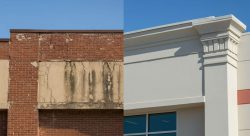
For a seasonal look at how Indiana weather affects EIFS, see why winter is the worst time to ignore EIFS damage.
What Weather Means for the Bid Scope
Contractors should address seasonal factors in their proposals:
- Temperature requirements. EIFS base coat and finish coat products typically require ambient and surface temperatures above 40°F during application and for at least 24 hours after (always check the manufacturer data sheet for the specific product being used). Bids for early spring work should account for weather delays or heated enclosure costs.
- Moisture conditions. Substrate moisture content should be tested before application. Bids should specify that substrate moisture must fall below manufacturer limits before new lamina is applied.
- Sequencing considerations. Flashing and WRB work typically happens first, followed by insulation board, base coat, and finish coat. If weather interrupts the sequence, the contractor needs a plan for protecting exposed wall sections.
For more on cold-weather EIFS work, Indiana Wall Systems has documented the process of winter EIFS repair with heated enclosures and cure control.
Understanding EIFS Repair Contract Language
Beyond the scope of work itself, the contract language matters. Several terms show up in EIFS repair contracts that property owners should understand before signing.
Fixed Price vs. Time and Materials
Fixed price (lump sum) contracts set one number for the entire job. The contractor absorbs cost overruns. The owner pays exactly the agreed amount unless a change order is issued.
Time and materials (T&M) contracts bill for actual labor hours and material costs plus a markup. The owner carries the risk of cost overruns because there is no ceiling.
Most EIFS repair projects work best with a fixed-price base bid plus unit-priced allowances for unknowns. This combines the predictability of a fixed price with the flexibility to handle hidden damage fairly.
Key Contract Terms to Review
| Contract Term | What It Means | Why It Matters |
|---|---|---|
| Inclusions | Work that is specifically covered by the bid price | Defines the minimum scope |
| Exclusions | Work that is specifically NOT included | Identifies potential gaps |
| Allowances | Pre-agreed pricing for work that cannot be fully scoped | Handles hidden damage fairly |
| Alternates | Optional work priced separately | Lets the owner add scope without rebidding |
| Change order triggers | Conditions that allow the contractor to request additional payment | Prevents surprise charges |
| Repair verification inspection | Final inspection to confirm work meets spec | Protects quality |
| Workmanship warranty | Contractor’s guarantee of the repair quality | Defines post-completion accountability |
Exclusions and Assumptions
Every bid should clearly list its exclusions (things the bid does NOT cover) and assumptions (conditions the bid is based on).
Common EIFS repair exclusions include:
- Interior drywall or finish repairs caused by prior moisture damage
- Landscaping restoration after scaffolding
- Permits or engineering fees (if required)
- Testing by third-party consultants
Common EIFS repair assumptions include:
- Substrate is structurally sound (unless an allowance is included)
- Access is available from ground level or with standard scaffolding
- Existing EIFS manufacturer and system type are identified
- Weather conditions will permit work during the scheduled window
If a bid does not list exclusions and assumptions, the owner has no way to know what is, or is not, included.
The Pre-Bid Walkthrough: Getting Contractors Aligned
One of the most effective ways to get comparable EIFS repair bids is to conduct a pre-bid walkthrough with all bidding contractors (either together or separately) at the property. During this walkthrough, the property owner or their representative provides:
- A copy of the EIFS inspection report with identified problem areas marked
- The scope of work checklist (from the section above) with every item that must be addressed
- Access to all sides of the building, including any areas requiring ladder or lift access
- Information about the EIFS manufacturer and system type, if known
- Any prior repair history or known issues (previous leaks, prior patches, etc.)
What to Ask During the Walkthrough
Property owners should ask each contractor specific questions during the walkthrough:
- “How will you determine the full extent of the moisture damage?”
- “What flashing details will your repair include at the windows and doors?”
- “What happens if you find damaged sheathing or framing behind the EIFS?”
- “Will you match the existing finish texture and color, and how?”
- “What is your change order process if additional damage is found?”
- “What warranty do you provide on the workmanship?”
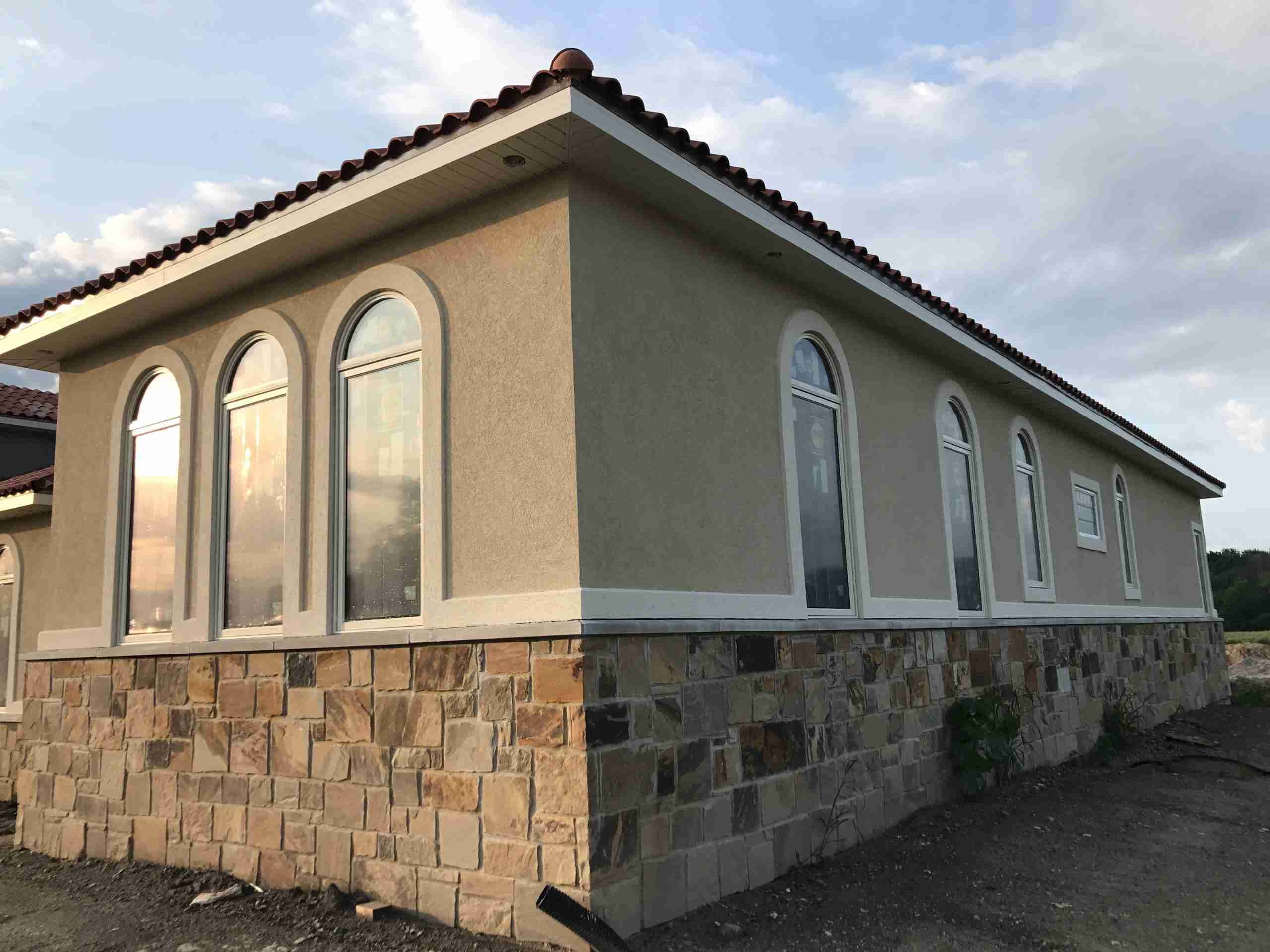
These questions force the contractor to articulate their approach, and the answers will directly reflect in the quality of their proposal.
EIFS Contractor Evaluation Criteria
Price is only one factor. The following criteria help property owners evaluate EIFS repair contractors beyond the dollar amount.
Qualifications and Experience
- How many years has the contractor been performing EIFS repairs specifically (not general stucco or construction)?
- Is the contractor certified by the EIFS manufacturer whose products are on the building?
- Does the contractor carry adequate insurance, including general liability and workers’ compensation?
- Can the contractor provide references for similar EIFS repair projects in the area?
Indiana Wall Systems’ team brings over 160 years of combined experience in EIFS work, with manufacturer certifications across the major EIFS brands used in the United States. That level of specialization matters because EIFS repair is not the same as painting, general contracting, or even traditional stucco work.
Communication and Documentation
- Does the contractor provide a written scope of work with the proposal?
- Will the contractor supply photo documentation of all repair phases (before, during, and after)?
- Is the change order process clearly defined?
- Does the contractor provide a repair verification inspection at the end of the project?
- Is the warranty in writing with clear terms?
Good EIFS contractor communication clarity starts with the bid itself. A proposal that is detailed, organized, and easy to understand reflects how the contractor will manage the project.
Repair Sequencing: What Comes First
EIFS repair projects follow a specific sequence. Understanding this helps property owners evaluate whether a contractor’s proposed timeline makes sense.
Typical EIFS Repair Sequence
- Site protection and staging. Scaffolding or lift setup, ground protection, covering of adjacent surfaces.
- Existing sealant removal. Old sealant is cut out from joints around windows, doors, and penetrations.
- Lamina removal. Damaged EIFS (finish coat, base coat, mesh, and foam) is removed to expose the substrate.
- Substrate inspection and repair. Sheathing and framing are inspected. Damaged substrate is replaced.
- Flashing installation. New flashing is installed at all window, door, and roof-to-wall transitions. The WRB is tied in to create a continuous weather-resistive barrier.
- EPS insulation board installation. New foam board is adhesively or mechanically attached, rasped, and shaped.
- Base coat and mesh application. Reinforcing mesh is embedded in the base coat in a two-pass system.
- Finish coat application. The acrylic finish is applied with texture and color matched to existing walls.
- Sealant installation. New backer rod and sealant are installed in all joints.
- Finish blending. Repaired areas are blended with surrounding wall surfaces.
- Cleanup and final inspection. Site is cleaned, scaffolding removed, and a repair verification inspection is performed.
A bid that skips steps (particularly steps 4, 5, and 10) is a bid that will produce problems later.
EIFS Repair Scope for HOA and Multi-Unit Properties
HOA board members and property managers face a unique version of the bid comparison challenge. Multi-unit properties often need phased repairs across several buildings, which adds complexity to the scope.
Additional Scope Items for HOAs
Beyond the standard scope of work checklist, HOA boards should ensure each bid addresses:
- Phasing plan. Which buildings or units will be repaired first, second, and third?
- Unit-owner communication plan. How will residents be notified of work schedules and access restrictions?
- Common area vs. unit-owner responsibility. Which repairs are the HOA’s responsibility and which fall to individual unit owners?
- Reserve fund alignment. Does the bid pricing align with the HOA’s reserve study and annual budget?
- Mobilization scope. Will the contractor mobilize once for the entire project or separately for each phase? Separate mobilizations cost more.
For HOA-specific guidance, see HOA and condo EIFS reserve planning, inspections, phasing, and budgeting.
The Role of the Inspection Report in Bid Development
An EIFS inspection report is the starting document for every repair scope. It identifies where moisture is present, where the system has failed, and where further investigation is needed.
What the Inspection Report Provides
A proper EIFS inspection report typically includes:
- Moisture probe readings at multiple locations around the building
- Visual observations including cracks, staining, biological growth, sealant failures, and surface damage
- Identified failure points at windows, doors, roof-to-wall transitions, penetrations, and terminations
- Recommendations for repair, further investigation, or monitoring
- Photos documenting each finding with location references
How the Report Feeds the Scope
Each finding in the inspection report should map to a line item in the repair scope. For example:
- Report finding: Elevated moisture readings at three window locations on the north elevation.
- Scope response: Exploratory openings at those three locations. If substrate damage is confirmed, lamina removal and replacement at the identified windows, plus flashing integration at head, sill, and jambs.
A contractor who writes a bid without referencing the inspection report is working from assumptions, not data. That approach leads to scope gaps and change orders.
How to Request EIFS Repair Bids the Right Way
Pulling all of this together, here is the step-by-step process for requesting comparable EIFS repair bids:
Step-by-Step: How to Get Apples-to-Apples EIFS Repair Bids
Hire a qualified EIFS inspector (not a bidding contractor) to produce a moisture mapping report and condition assessment. This report becomes the baseline for all bids.
Use the checklist in this guide. Mark every item that applies to the property and include it in your bid request package.
Look for contractors with verified EIFS experience, manufacturer certifications, and proper insurance. Not general contractors, painters, or siding installers.
Walk each contractor through the property with the inspection report and scope checklist. Answer questions. Provide full access to the building exterior.
Ask each contractor for unit pricing on lamina, sealant, substrate repair, and finish blending. Request per-unit allowances for unknowns.
Use the bid comparison worksheet to place every proposal side by side. Compare line by line, not total price alone.
If a contractor excluded items from the checklist, ask why. If quantities differ significantly between bids, ask each contractor to explain their assessment.
Repair Scope vs. Full Replacement: Knowing the Difference
Sometimes the scope of work exercise reveals that repairs alone will not solve the problem. Older barrier-type EIFS (systems built without a drainage plane, common in the 1990s) may need a full system removal and replacement rather than localized repairs.
When Repairs Are Appropriate
- Damage is localized to specific areas (a few windows, one wall face, a single penetration)
- The existing EIFS system includes a drainage plane and was properly installed
- The substrate behind the damage is structurally sound
- The EIFS inspection report does not show widespread elevated moisture
When Full Replacement May Be Needed
- Moisture damage is found across multiple walls and elevations
- The existing system is an older barrier EIFS without drainage capability
- Substrate damage (sheathing rot, framing deterioration) is extensive
- The cost of localized repairs approaches 50% or more of a full replacement cost
For a deeper comparison, see EIFS repair vs. full replacement: making the smart choice.
What Good EIFS Repair Documentation Looks Like
After the project is complete, the contractor should provide documentation that creates a permanent record of the work performed. This documentation protects the owner during future inspections, real estate transactions, and warranty claims.
Minimum Documentation Requirements
A thorough EIFS repair documentation package includes:
- Before photos of all damaged areas with location references
- During photos showing substrate condition, flashing installation, mesh embedding, and base coat application
- After photos of completed repairs with finish blending results
- Moisture probe readings taken before and after the repair
- Material specifications for all products used (manufacturer, product name, lot numbers where applicable)
- Written workmanship warranty with terms, coverage, and claim process
- Manufacturer compliance letter if the contractor is a certified applicator
This documentation package becomes especially valuable if the property is sold. Buyers, real estate agents, and appraisers want to see that repairs were done correctly, by a qualified contractor, using manufacturer-approved products and methods. For more on how EIFS affects property sales, see how to prep and sell your EIFS stucco home or commercial building.
Common Scope Gaps That Lead to EIFS Repair Failures
Even with a good checklist, some scope items are missed more often than others. These gaps do not always show up in the bid, but they show up in the field when the repair fails prematurely.
Top 5 Scope Omissions
- Sealant primer. Many sealant products require a primer on the substrate for proper adhesion. Skipping the primer means the sealant may peel away within a year or two, re-opening the joint to water. The sealant primer specification should be listed in the bid.
- Backer rod sizing. Backer rod controls the depth of the sealant joint and creates the “hourglass” shape needed for proper elasticity. The wrong diameter allows the sealant to bond to three surfaces instead of two, which causes early failure. The bid should specify backer rod installation with the correct diameter for each joint width.
- WRB tie-in. If the repair exposes the substrate, the contractor needs to tie the new water-resistive barrier into the existing barrier above and to the sides. Without this step, water runs behind the new repair and enters the wall at the transition. The WRB tie-in is a scope item that separates experienced EIFS contractors from general repair crews.
- Termination details. Where the EIFS ends at the foundation (grade termination), at the roofline (head termination), or at a material transition (e.g., EIFS to brick), the system needs specific detailing to prevent water entry. These EIFS termination details are often omitted from bids because they are labor-intensive.
- Control and expansion joints. EIFS panels expand and contract with temperature changes. Without properly placed and sealed control joints, the system cracks. If the original building lacked adequate joints, the repair scope should address this. EIFS expansion joint repair and control joint repair should appear as separate line items.
Understanding Pricing Structures in EIFS Repair Bids
How a contractor structures the price tells the owner a lot about how the project will be managed.
Three Common Pricing Approaches
1. Lump sum (fixed price)
The entire project is priced as one number. The scope is defined, and the price does not change unless a written change order is issued. This works well for clearly defined projects with minimal unknowns.
2. Unit pricing with a guaranteed maximum
Each scope category has a per-unit price, and the total has a cap. The owner pays for actual quantities used, up to the maximum. This is ideal for EIFS repairs because the full extent of damage is rarely known until demolition begins.
3. Time and materials (T&M)
Labor and materials are billed at actual cost plus a markup. There is no cap. This is the riskiest structure for the owner because there is no incentive for the contractor to be efficient. T&M should only be used for very small or emergency repairs where scoping the work is impractical.
The best EIFS repair pricing structure for most projects is a fixed-price base bid with unit-priced allowances for substrate repair, additional lamina work, and unforeseen conditions. This gives the owner budget certainty for the known scope and fair pricing for the unknown scope.
Contractor Accountability After the Bid
The bid is not the end of the evaluation process. Once a contractor is selected, their accountability should continue through the project and beyond.
During the Project
- The contractor should provide a project timeline with milestone dates for each phase of the repair sequence.
- Weekly or phase-based progress reports with photos keep the owner informed.
- All change orders should be documented in writing with photo evidence of the condition that triggered them, the proposed scope, and the cost impact.
- The contractor should maintain site protection to prevent damage to landscaping, driveways, and adjacent surfaces during the work.
After the Project
- A repair verification inspection confirms that all scope items were completed as specified.
- The contractor provides the full documentation package (photos, materials list, warranty).
- The written workmanship warranty takes effect on the date of completion and should specify the term, what it covers, and how claims are filed.
Frequently Asked Questions
How many EIFS repair bids should a property owner get?
Three to four bids from qualified EIFS contractors provides enough data to compare scope, pricing, and approach without creating unnecessary complexity. More bids do not always help. The quality of each bid matters more than the quantity. Focus on contractors with documented EIFS repair experience and manufacturer certifications.
What is the most important line item in an EIFS repair bid?
Flashing integration at windows, doors, and roof-to-wall transitions is one of the most critical scope items. Poor or missing flashing is one of the leading causes of EIFS moisture intrusion failures. A bid that repairs the wall surface but ignores flashing is setting the property up for repeat damage within a few years.
Should I hire the same contractor who did the EIFS inspection to do the repair?
Using the same contractor for both inspection and repair can create a conflict of interest because the inspector may identify more damage than actually exists to increase the repair scope. An independent inspection by a separate party produces the most objective results. The repair contractor should then price the work based on those independent findings.
How long do EIFS repairs typically take in Central Indiana?
Repair timelines depend on the scope, the season, and the weather. A localized repair on a single wall face might take one to two weeks. A multi-elevation project with extensive substrate damage can run four to eight weeks or longer. Weather delays during spring and fall are common in Indiana. The contractor should include a realistic timeline and a weather contingency plan in their proposal.
What warranty should I expect on EIFS repair work?
Many specialized EIFS contractors offer 3 to 5+ year written workmanship warranties on repair work. Ask for it in writing and compare coverage between bidders. Indiana Wall Systems offers competitive warranty terms depending on the project scope. The warranty should be separate from any manufacturer product warranty and should clearly state what is covered, what is excluded, and how the owner can file a claim.
Can I use this checklist for new EIFS installation bids too?
This checklist is specifically designed for EIFS repair projects where an existing system has failed or been damaged. New installation bids require a different scope framework that includes full system specifications, substrate preparation from bare framing, and architectural detailing. However, the principles of unit pricing, clear scope definitions, and bid normalization apply to new installations as well.
Key Insights
Scope drives everything. The number-one reason EIFS repair bids look different is that each contractor defines the work differently. A standardized scope checklist eliminates guesswork and makes price comparisons meaningful.
Unit pricing prevents surprises. Per-square-foot and per-linear-foot pricing for key repair items gives the owner a clear cost framework. Change orders become predictable, not adversarial.
Flashing is non-negotiable. Any EIFS repair bid that omits flashing integration at windows, doors, and roof-to-wall transitions is leaving one of the biggest moisture entry points unaddressed.
Allowances protect both sides. Pre-agreed allowances for substrate repair, additional lamina work, and exploratory openings handle the unknowns that every EIFS repair project carries.
The lowest bid is rarely the best value. A lower total with missing scope items is not cheaper. The missing work shows up later as change orders, repeat repairs, or premature system failure.
Need a Detailed EIFS Repair Scope of Work?
Indiana Wall Systems provides detailed, line-item EIFS repair proposals with unit pricing, allowances, and written warranties. Serving Central Indiana for over 26 years.