
End Dams, Drip Throats, And ES-1 Tested Securement: The Coping Checklist That Stops Parapet Leaks
Parapet walls are among the most leak-prone areas on any commercial building, and the coping cap is usually where problems start. When an Exterior Insulation and Finish System (EIFS) wraps a parapet, the coping details determine whether water stays out or finds its way into the wall assembly. A properly sloped cap with end dams, hemmed drip edges, and correctly designed sealant joints keeps the system watertight. Missing any of these details lets water behind the cladding, where rot, mold, and costly structural damage follow quickly.
The roof-to-wall transition creates a critical junction where water, wind, and thermal movement all converge. The parapet itself is a short wall that extends above the roof line. It conceals rooftop equipment, provides fall protection, and creates architectural interest. On commercial buildings throughout central Indiana, parapets range from 18 inches to several feet tall. Each inch of that height requires flashing, terminations, and coping that must resist decades of weather exposure.
Indiana Wall Systems has spent over 26 years repairing commercial EIFS across central Indiana. Parapet failures show up on office buildings, strip malls, hotels, and multifamily properties throughout Indianapolis, Carmel, Fishers, and surrounding communities. The problems are predictable, and the fixes are well documented in industry standards from EIMA, ASTM, and FM Global. The challenge is getting all the details right during installation, or finding and fixing them when something goes wrong.
“Parapets are where everything meets,” says Jeff Johnson, CEO of Indiana Wall Systems. “You have the roofer, the EIFS contractor, the sheet metal fabricator, and the caulking crew all working on the same 12 inches of building. If anyone misses their mark, the building leaks.”
This guide breaks down EIFS parapet coping details, explains how water gets in, and outlines what proper repairs look like. Property managers, building owners, and facility directors will find practical information for evaluating their buildings and planning repairs.
Key Takeaways
- Parapets fail more often than field walls because they face weather exposure on multiple sides, experience extreme thermal movement, and require precise coordination between roofing, EIFS, and sheet metal trades.
- Missing end dams at coping joints are the single most common defect found in central Indiana commercial buildings, allowing water to run sideways along the coping channel and drip into wall cavities.
- Coping must slope toward the roof (at least 1/4 inch per foot), not toward the building exterior. Flat or outward-sloping coping causes ponding, ice formation, and accelerated joint failure.
- Sealant joints require two-sided adhesion, not three. Using bond breaker tape or properly sized backer rod prevents the sealant from bonding to the back of the joint, which allows it to stretch without tearing.
- Stainless steel fasteners and clips prevent galvanic corrosion between dissimilar metals. Steel fasteners behind aluminum coping create rust stains and premature failure.
- Water-managed EIFS with a drainage plane is preferred over barrier EIFS at parapets because any water that enters has an escape path rather than accumulating behind the lamina.
- Annual inspections and sealant maintenance catch problems early, before substrate damage spreads. Most parapet repairs cost far less when addressed before rot reaches framing members.
EIFS Parapet Coping: Where Leaks Begin
The coping cap is the first line of defense against water intrusion at parapet walls. When details fail, damage spreads fast.
on Commercial Buildings
Detail Failures
When Ignored
Why Parapet Walls Fail More Often Than Field Walls
Parapets sit at the intersection of the roof system and the wall assembly. This position subjects them to stresses that field walls (the large flat expanses of cladding) rarely experience.
Exposure on Multiple Sides
A typical wall faces weather on one side. Parapets catch wind-driven rain from the exterior, rising heat and moisture from the roof below, and often direct sunlight on top. The coping cap bakes in summer and freezes in winter, cycling through temperature extremes every day.
Consider a hot August afternoon in Indianapolis. The coping surface might reach 160°F in direct sun. A sudden thunderstorm drops that temperature by 50 degrees in minutes. This rapid thermal shock stresses sealant joints, warps metal, and opens gaps that stay open when the metal cools further overnight.
Thermal and Structural Movement
Metal coping expands and contracts with temperature swings. A 20-foot aluminum coping run can move nearly a quarter inch between a hot summer afternoon and a cold winter night. Without proper expansion joints and slip connections, that movement cracks sealant, pops fasteners, and opens gaps at splice joints.
The coefficient of thermal expansion for aluminum is roughly twice that of steel. Specifiers must account for this difference when selecting materials and designing joints. Many parapet failures trace back to expansion joint spacing that assumed steel behavior on an aluminum coping system.
Water Accumulation Points
Rainwater flows downhill. Parapets are often the lowest point on a building’s edge before the roof drains. Any ponding near the parapet base, any pooling in low spots on the coping cap, or any backup behind scuppers puts extra hydraulic pressure on every joint and termination.
Hydrostatic pressure at coping seams increases dramatically during heavy rain events. A pooled depth of just one inch creates enough pressure to force water through gaps that would shed a normal rain. Indiana’s summer storms often deliver 2 or 3 inches of rain in an hour, overwhelming drainage systems and testing every parapet detail.
Complex Trade Sequencing
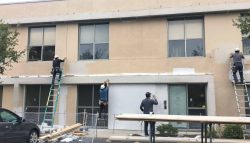
Building a watertight parapet requires roofing contractors, EIFS applicators, sheet metal fabricators, and sealant installers to work in a specific sequence. The roof membrane turns up the parapet face. The EIFS terminates above the membrane with a drip edge or termination bead. The coping cap overlaps everything. If one trade arrives out of order, or if details are not coordinated, gaps appear.
Scheduling conflicts on busy commercial projects sometimes force trades to work out of sequence. The result is often a parapet where components do not lap correctly, where flashing terminates under rather than over adjacent materials, or where sealant joints cannot accommodate the required movement.
Anatomy of an EIFS Parapet Assembly
Understanding the layers helps explain where leaks originate.
Structural Framing
Commercial parapets use steel studs, CMU (concrete masonry units), or wood nailer blocking attached to the roof deck edge. Proper blocking attachment to the deck edge resists wind uplift. Fasteners must penetrate structural members, not just sheathing.
Sheathing and Substrate
Glass mat gypsum sheathing or cement board substrate forms the base for the EIFS. These materials resist moisture better than paper-faced gypsum, which can wick water and delaminate quickly.
Water-Resistive Barrier and Air Barrier
A continuous water-resistive barrier (WRB) wraps the parapet, lapping correctly at corners and terminations. Many modern EIFS assemblies also serve as the building’s air barrier. Maintaining air barrier continuity at the roof-to-wall transition requires careful detailing with transition membranes.
EIFS Lamina
The EIFS itself consists of adhesive or mechanically attached EPS insulation boards, a base coat with embedded fiberglass mesh, and an acrylic finish coat. At parapet edges, backwrapping at EIFS terminations protects exposed foam from UV damage and moisture infiltration.
Termination Accessories
Drip edge beads, termination beads, and starter tracks finish the EIFS edges. The termination detail at the parapet top must create a capillary break and shed water away from the wall face.
Coping Cap
The metal coping cap covers the parapet top. It must slope toward the roof (never toward the building exterior), overlap the EIFS termination, include hemmed drip edges on both faces, and connect at joints with proper expansion allowances.
Sealant Joints
Sealant fills the gap between the coping and the EIFS, between coping sections at splice joints, and at end conditions. Proper joint design follows ASTM C1193 guidance: two-sided adhesion with a bond breaker tape or backer rod, not three-sided adhesion that restricts movement.
Common Coping Failure Modes
When property managers call Indiana Wall Systems about parapet leaks, certain problems appear again and again. Understanding these failure modes helps building owners recognize warning signs and communicate effectively with contractors.
⚠️ 7 Coping Failures That Cause Parapet Leaks
Any one of these defects can allow water into the wall assembly
Coping Joints Without End Dams
A coping end dam is a vertical flange welded or folded into the coping at each splice. Without end dams, water runs sideways along the coping’s interior channel and drips down into the wall cavity. This is one of the most common defects in central Indiana commercial buildings.
End dams create a small reservoir at each joint. Water that enters through the sealant joint pools behind the dam rather than running into the wall. A properly sized dam stands at least 1 inch tall, though 1.5 to 2 inches provides better protection.

Coping splice end dams at straight runs and coping corner end dams at direction changes serve the same function. Factory fabrication produces cleaner, more reliable end dams than field modifications.
Positive Slope Missing or Reversed
Coping caps must slope toward the roof, not toward the building face. A positive slope coping cap with at least 1/4 inch per foot ensures water drains away from the exterior wall. If the coping is flat or slopes outward, water ponds, freezes, and penetrates joints.
Some installers mistakenly slope coping toward the exterior wall, reasoning that water should drain “off” the building. This approach sends water directly at the wall face and the critical EIFS termination. Outward-sloping coping also promotes icicle formation that can damage the EIFS finish below.
Tapered coping for drainage achieves positive slope through the coping’s cross-sectional shape rather than tilting the entire assembly. This approach maintains a level appearance while ensuring proper water shedding.
Coping Cap Slope Direction Matters
(min. 1/4″ per foot)
Water drains to roof drains
or flat/level
Water attacks wall face
Inadequate Drip Edges
A proper drip edge projects far enough from the wall face (typically 1 to 1.5 inches) and includes a hemmed drip edge with a formed return that creates a drip throat. Short drip edges let water curl back against the EIFS. Missing drip throats allow capillary action to pull water into the wall.
The drip throat under coping (sometimes called a drip kerf) is a groove or bend that interrupts water film traveling along the metal surface. Without this feature, surface tension pulls water up and over the edge, depositing it against the wall.
Capillary break at coping edge details prevent water from bridging small gaps through capillary action. Proper drip edge design creates enough separation that water falls free rather than wicking into the assembly.
Insufficient Coping Overlap on EIFS
The coping’s back leg must extend far enough down the parapet’s interior face, and the front face must cover the EIFS termination with enough overlap to prevent wind-driven rain from entering. Parapet cap minimum overlap on EIFS is typically 2 to 3 inches.
Coping back leg height affects how well the assembly handles water that gets past the termination bar. Coping face height coverage determines protection against wind-driven rain. Both dimensions must account for worst-case weather conditions, not just normal rainfall.
Sealant Joint Design Errors
Three common sealant mistakes cause failures:
- Three-sided adhesion: Sealant bonds to the coping, the EIFS, and the backer rod. Movement tears the sealant apart because the sealant cannot stretch in three directions simultaneously.
- Joints too narrow or too shallow: Sealant cannot stretch enough to accommodate thermal movement. A sealant joint too narrow fails when the joint opens. A sealant joint too shallow fails when the thin sealant section tears.
- Missing primer: Many substrates require primer for proper adhesion. Sealant primer compatibility must be verified for each substrate. Without proper primer, the sealant peels away in what is called adhesive sealant failure.
Sealant Joint Design: Right vs. Wrong
| Detail | Correct | Incorrect |
|---|---|---|
| Adhesion | 2-sided | 3-sided |
| Width-to-Depth | 2:1 ratio | 1:1 or deeper |
| Min. Width | 1/4 inch | Less than 1/4″ |
| Profile Shape | Hourglass | Flat or convex |
| Backer Rod | 25% oversized | Undersized/missing |
Per ASTM C1193 joint design guidance
The proper sealant profile is an hourglass sealant profile that is wider at the bonding surfaces and narrower in the middle. This shape distributes stress evenly when the joint moves. Bond breaker tape at sealant joint or proper backer rod placement prevents three-sided adhesion.
Fastener Backout
Wind uplift and thermal cycling loosen fasteners. Fastener backout at coping cleats lifts the coping, opening gaps and creating entry points for water. The coping clip spacing and coping clip pullout resistance must exceed expected wind loads.
Specifiers must ensure the cleat gauge heavier than coping gauge to prevent the cleat from deforming before the fasteners fail. This hierarchy of failure modes keeps the system repairable rather than replacing everything.

Wind uplift resistance at coping is tested under ANSI/SPRI/FM 4435 ES-1 (the RE-3 test for copings). Buildings in high wind zones require tested assemblies with documented performance.
Dissimilar Metal Corrosion
Aluminum coping installed with steel fasteners or cleats corrodes at contact points. Dissimilar metal galvanic corrosion accelerates when moisture is present, exactly the conditions found at parapet joints.
Stainless steel coping clips and stainless steel fasteners at coping prevent galvanic corrosion. The additional cost of stainless hardware is minor compared to the cost of premature replacement.
Aluminum coping corrosion risk increases near coastal areas or locations with road salt exposure. Indiana’s winter road treatments create a corrosive environment for any exposed metal.
Industry Standards and Code Requirements
Multiple standards govern parapet coping installation. Architects specify, inspectors enforce, and contractors must understand these references.
📋 Key Standards for Parapet Coping
IBC 1504.6: Edge Systems
The International Building Code requires that roof edge systems resist wind loads. Metal copings must be tested and rated for the project’s wind exposure.
ANSI/SPRI/FM 4435 ES-1 (RE-3 for Copings)
This test standard measures coping performance under simulated wind uplift. ES-1 compliant coping assemblies include specific cleat gauges, fastener spacing, and interlock designs. Many specifiers require FM Approved perimeter flashing for insurance purposes.
FM Global Data Sheet 1-49
FM Global’s Data Sheet 1-49 provides detailed guidance on perimeter flashing and coping. It addresses cleat gauge requirements (the cleat must be heavier gauge than the coping face), fastener pull-out resistance, and edge securement for copings in high-wind zones.
ASTM C920: Sealant Classification
Elastomeric sealants used at coping joints must meet ASTM C920 requirements. The sealant movement capability rating (such as +/- 25% or +/- 50%) must match the expected joint movement.
ASTM C1193: Joint Design
This guide explains proper joint width-to-depth ratios, backer rod selection, and bond breaker placement. Following ASTM C1193 joint design guidance prevents premature sealant failure.
EIMA Guide to EIFS with Drainage Detailing
The EIFS Industry Members Association (EIMA) publishes detail drawings for parapets. The EIMA Guide to EIFS with Drainage Detailing shows proper termination beads, mesh returns, and coping integration.
Manufacturer Specifications
Each EIFS manufacturer (Dryvit, Sto, Master Wall, Senergy) publishes parapet details. These system-specific documents define compatible accessories, required overlaps, and warranty conditions.
Coping System Types and Selection
Different coping systems suit different conditions. The choice affects installation complexity, maintenance requirements, and long-term performance.
Concealed Fastener Systems

Concealed fastener coping systems use continuous or intermittent cleats screwed to the parapet top. The coping cap snaps or hooks onto the cleat, hiding fasteners from weather exposure. Advantages include better appearance and reduced fastener corrosion risk.
Continuous Cleat vs. Intermittent Cleat
A continuous cleat coping system provides uniform support and wind resistance. An intermittent cleat coping system uses shorter cleat segments at regular intervals. Continuous cleats cost more but perform better in high-wind areas.
Receiver and Cap Systems
Receiver and cap coping systems use a base receiver that attaches to the parapet, then a separate cap that snaps into the receiver. This two-piece approach simplifies replacement and repair.
Face-Fastened Systems
Budget projects sometimes use face-fastened coping with exposed screws. Exposed fasteners are more prone to leaks, corrosion, and loosening over time. Indiana Wall Systems rarely recommends face-fastened coping for EIFS parapets.
Coping Joint Details That Work
The joints between coping sections determine whether the assembly stays watertight.
Splice Plate Joints
A coping joint splice plate is a flat metal section that bridges the gap between two coping pieces. Sealant fills the gap above the splice plate. End dams on each coping section contain water above the splice.
Slip Joints
Coping slip joints allow thermal movement. One coping section telescopes into the next, with a gap sealed by sealant. The sliding connection absorbs expansion and contraction without buckling.
Expansion Joints
At long parapet runs, dedicated coping expansion joints break the coping into segments. Movement joint spacing depends on material type: aluminum moves more than steel. Most specifiers place expansion joints every 20 to 30 feet for aluminum, 40 to 50 feet for steel.
Movement Joint Planning
Coping movement joint planning anticipates thermal cycling. Joints must be located where movement accumulates, typically at corners and long runs. A containment zone for coping movement ensures sealant joints can accommodate predicted expansion.
Corner Treatment
Inside and outside corners require special fabrication. Coping corner end dams prevent water from running into corner joints. Factory-welded corner pieces or field-soldered seams provide continuous metal at corners.
Roof Membrane Termination Types at Parapets
Different roofing systems terminate at parapets in different ways. Understanding these variations helps EIFS contractors coordinate with roofers.
Single-Ply Membrane Systems
TPO parapet flashing termination and PVC parapet flashing termination use heat-welded membrane that turns up the parapet face. The membrane typically extends 8 to 12 inches above the roof surface and terminates under a compression termination bar.
EPDM parapet flashing termination requires adhesive or seam tape rather than heat welding. Proper surface preparation is critical for adhesion.

All single-ply systems require roof base flashing height adequate for expected water depth during drainage backup events. Roof base flashing securement must resist wind uplift and prevent the membrane from pulling away from the parapet surface.
Built-Up and Modified Bitumen
Modified bitumen parapet flashing uses torch-applied or self-adhered sheets. Hot-applied rubberized asphalt flashing provides excellent adhesion but requires careful temperature control during application.
Built-up systems use multiple layers of felt and bitumen to create redundant waterproofing. The layers must extend far enough up the parapet to prevent overflow events from reaching the membrane edge.
Liquid-Applied Membranes
Liquid-applied transition membrane products bridge gaps between different roofing and wall materials. These products are especially useful when retrofitting EIFS to existing buildings with various roof types.
Common Membrane Termination Failures
Roof membrane termination failures include:
- Fishmouths in membrane flashings: Buckles or wrinkles that trap water
- Punctures at parapet corners: Damage from foot traffic or maintenance equipment
- Counterflashing not covering termination: The cover flashing does not extend far enough down to protect the membrane edge
Inside corner roof flashing detail and outside corner roof flashing detail require pre-formed corners or careful field fabrication. Corners are weak points where multiple failure modes converge.
Counterflashing and Roof Membrane Integration
The coping cap does not work alone. It integrates with counterflashing and roof membrane terminations.
Counterflashing Basics
Reglet counterflashing inserts into a saw-cut groove in masonry or concrete. Surface-mounted counterflashing attaches directly to the wall face with fasteners and sealant. Two-piece counterflashing allows the outer cover to be removed for roof replacement without disturbing the base flashing.
Counterflashing Lap Joints
Where counterflashing sections meet, the upper piece laps over the lower piece by at least 4 inches. Counterflashing lap joints shed water like shingles, preventing backflow.
Kickout at Ends
At the ends of counterflashing runs, a counterflashing kickout diverts water away from the wall face rather than letting it run behind the termination.
Termination Bar
A termination bar and counterflashing combination secures the roof membrane turn-up. The compression termination bar presses the membrane against the substrate, and sealant covers the bar’s top edge. Termination bar fastener spacing is typically 6 to 8 inches on center.
Roof Membrane Turn-Up Height
The roof membrane must turn up the parapet face at least 8 inches (many codes require 12 inches or more). Insufficient roof membrane turn-up height allows water to reach the membrane’s top edge during heavy rains or snow melt.
Transition Membranes
Self-adhered transition membrane or liquid-applied transition membrane bridges the gap between different materials. A transition membrane under coping prevents water from reaching the parapet substrate even if the coping joint fails.
Through-Wall Flashing
On masonry parapets or at certain conditions, through-wall flashing at parapet locations provides a secondary drainage plane.
Materials
Stainless steel through-wall flashing resists corrosion indefinitely. Copper through-wall flashing is traditional but requires careful attention to galvanic isolation. Membrane through-wall flashing made from rubberized asphalt or TPO is less expensive but more difficult to detail correctly.
End Dams
Through-wall flashing with end dams prevents lateral water migration. Formed or soldered end dams at each flashing segment contain water and direct it to weep paths.
Laps and Splices
Through-wall flashing laps and splices must shed water correctly. Each upper piece overlaps the lower piece by 6 inches minimum. Sealant or tape bonds the splice.
Drip Edge Termination
The drip edge termination of through-wall flashing projects beyond the wall face to shed water clear of the cladding below.
Weep Paths
A weep path above through-wall flashing allows any water that reaches the flashing to drain to the exterior. Missing weeps trap water inside the wall.
Drainage Plane and Control Layer Continuity
Modern building science emphasizes continuous control of water, air, heat, and vapor. Parapets challenge all four.
Water Control Layer Continuity
The water-resistive barrier continuity must extend from the field wall, up the parapet face, across the top (if the coping does not provide full coverage), and down the back. Laps must shed water downward.
Air Control Layer Continuity
Air barrier continuity at roof-to-wall transitions often requires air barrier transition membrane to connect the wall’s air barrier to the roof’s. Air leaks through parapet assemblies waste energy and carry moisture into wall cavities.
Thermal Control Layer Continuity
Continuous insulation termination at parapet must avoid gaps. Thermal bridging at parapet framing occurs when steel studs or blocking conduct heat directly through the assembly. Insulating the parapet top helps reduce thermal bridging.
Vapor Control Strategy
Vapor control strategy at parapets depends on climate zone. In Indiana (climate zone 5), vapor retarders typically belong on the warm side of the assembly. Condensation risk at parapet cap increases if warm, moist interior air contacts a cold coping surface.
EIFS-Specific Parapet Detailing
EIFS brings unique considerations to parapet assemblies.
Drainage EIFS at Parapet Returns
EIFS drainage EIFS at parapet return refers to carrying the drainage cavity (the air gap behind the EPS insulation board) around the parapet. Water that enters the system drains down to the base of the wall rather than accumulating behind the parapet.
Barrier EIFS Risk
Barrier EIFS risk at parapet tops is significant. Barrier EIFS (systems without drainage cavities) depend entirely on the lamina to keep water out. Any crack at the parapet, any sealant failure, any coping defect allows water into the system with no escape path.
Backwrapping
Backwrapping at EIFS terminations wraps the mesh and base coat around exposed EPS edges. Without backwrapping, foam edges deteriorate from UV exposure and absorb water.
Termination Beads and Drip Edges
A termination bead at EIFS roofline provides a clean edge and a capillary break. A drip edge accessory for EIFS terminations sheds water away from the wall face.
Corner Reinforcement
EIFS corner mesh reinforcement at parapet corners resists impact and stress cracking. Diagonal mesh at corners placed at 45 degrees adds strength. High-impact mesh at parapet edges withstands maintenance traffic and accidental contact.
Starter Track Considerations
Starter track termination considerations include ensuring the track drains, does not create a water dam, and ties into the coping flashing correctly.
Signs of Parapet and Coping Failure
Property managers and building owners should watch for these warning signs.
Visible Indicators
🔍 Warning Signs of Parapet Failure
| What You See | Likely Cause |
|---|---|
| Water staining below coping | Coping joint failure, missing end dams |
| Rust streaks below coping joints | Steel fasteners corroding, dissimilar metal contact |
| Efflorescence at parapet walls | Water dissolving salts from masonry or morite |
| Bulging EIFS at parapet tops | Saturated EPS insulation, trapped moisture |
| Lamina cracking at parapet line | Thermal movement stress, inadequate expansion joints |
| Delamination of EIFS lamina | Adhesive failure from moisture intrusion |
Hidden Damage
Water staining inside the building, soft spots in the EIFS when pressed, and musty odors near exterior walls all indicate hidden damage. Wet insulation behind EIFS loses R-value and promotes mold growth. Sheathing deterioration from leaks weakens the structural attachment of the entire cladding system.
Health and Safety Implications
Mold growth from chronic leakage affects indoor air quality. Mildew behind parapet returns creates ongoing health concerns. Moisture intrusion hazards in EIFS include not just mold, but potential structural failure if framing members rot.
Inspection and Diagnostic Methods
Determining the source and extent of parapet leaks requires systematic investigation. Water intrusion forensic investigation starts with observation and proceeds through increasingly invasive testing until the leak path is confirmed.
Visual Inspection
A trained inspector examines coping joints, sealant condition, drip edge projection, and EIFS surface condition. Indiana Wall Systems conducts thorough visual inspections on every EIFS assessment project.
Visual indicators of parapet problems include:
- Gaps at coping splice joints
- Cracked or peeling sealant
- Rust stains below coping
- Efflorescence (white mineral deposits) on wall surfaces
- Soft or spongy EIFS when pressed
- Mold or mildew growth
- Interior water stains near roofline
Moisture mapping at parapet zones documents the location and extent of visible damage before repairs begin.
Infrared Thermography
Infrared thermography for moisture detects temperature differences caused by wet materials. Wet insulation holds heat differently than dry insulation, creating visible patterns on thermal images.
Thermographic surveys work best when:
- Exterior surfaces have been warmed by sun exposure
- Interior and exterior temperatures differ by at least 10°F
- Surfaces have dried from recent rain (looking for trapped moisture, not surface water)
The technique identifies wet areas but cannot determine how water entered. Additional testing locates the specific leak path.
Invasive Probes
Invasive probe testing behind EIFS involves cutting small openings to inspect sheathing, framing, and insulation. Probes are placed at locations identified by thermography or at common failure points like corners and terminations.
Borescope inspection behind EIFS uses a flexible camera to view concealed conditions through a small hole. This minimizes damage while providing visual confirmation of conditions.
Invasive testing reveals:
- Sheathing condition (rot, delamination, fastener corrosion)
- Insulation moisture content
- Framing condition
- Presence of mold or biological growth
- Flashing installation quality
Water Testing
Hose testing at coping joints applies controlled water spray to isolate leak paths. Starting at the lowest suspect location and working upward identifies the entry point. When water appears inside, the last tested location is the leak source.
Spray rack testing at wall areas simulates wind-driven rain using calibrated equipment. The test applies water at specific rates and pressures defined in AAMA 501.2.
Dye testing leak tracing adds colored dye to water to track its path through the assembly. Different colors can be used at different locations to distinguish multiple leak paths.
Flood testing roof membrane verifies that the membrane is watertight before investigating the parapet. Roof leaks sometimes track along structural members and appear at parapet locations.
ASTM E2128 Evaluation
ASTM E2128 water leakage evaluation provides a standard method for investigating building enclosure leaks. The protocol documents symptoms, hypothesizes leak paths, tests hypotheses, and confirms findings.
Following a standardized methodology ensures thorough investigation and provides documentation that supports warranty claims, litigation, or insurance recovery.
Repair Strategies for Parapet Coping Failures
Once the problem is identified, repairs must address both the immediate leak and the underlying detail defect. Quick fixes that treat symptoms rather than causes lead to recurring failures.
Sealant Replacement
Failed sealant joints require complete removal of old sealant, cleaning of substrates, application of primer (if required), installation of proper backer rod, and application of new sealant with an hourglass sealant profile. Tooling sealant for proper wetting ensures adhesion to both substrates.
The process follows this sequence:
- Remove all existing sealant using scrapers and solvents appropriate for the sealant type
- Clean joint surfaces to remove contaminants, oxidation, and residue
- Verify joint width and depth meet minimum requirements (typically 1/4 inch minimum width, width-to-depth ratio of 2:1)
- Install closed cell backer rod or open cell backer rod sized 25% larger than the joint width
- Apply primer if required by the sealant manufacturer for the specific substrates
- Gun sealant into the joint, filling from the bottom up
- Tool the sealant to create proper profile and ensure substrate wetting
UV degradation of sealant joints is more severe at parapets than at protected wall locations. Sealant at sun-exposed coping joints may need replacement 5 to 10 years sooner than the same sealant in shaded areas.
Coping Reseal vs. Replacement
Minor joint failures may be addressed by resealing. Extensive corrosion, improper slope, or missing end dams typically require replace coping with receiver system to correct the underlying defects.
Indicators that resealing alone will not work include:
- Rust-through corrosion on steel coping
- Pitting corrosion on aluminum coping
- Visible slope toward the building exterior
- Missing or damaged end dams
- Deformed cleats or backing material
- Failed fasteners with enlarged holes
When resealing is appropriate, it provides a cost-effective solution that extends coping life for another maintenance cycle.
Coping Removal and Reinstall
When coping must come off for repairs, a documented coping removal and reinstall procedure ensures nothing is damaged and all components go back correctly. Steps include:
- Photograph existing conditions before starting work
- Mark coping sections to record their original positions
- Cut sealant joints carefully to avoid damaging EIFS
- Lift coping sections and set aside for inspection
- Inspect and repair substrate, flashing, and EIFS terminations
- Replace damaged cleats and fasteners
- Reinstall coping in original sequence with proper laps
- Seal all joints with appropriate sealant
Reusing existing coping saves material cost but requires careful handling. Bent or damaged sections should be replaced rather than reformed.
Substrate Repair
If water has rotted sheathing or framing, replace damaged substrate at parapet before reinstalling cladding. Indiana Wall Systems often finds that apparent coping problems have caused hidden substrate damage requiring structural repair.
Glass mat gypsum sheathing at parapets resists moisture better than paper-faced alternatives. Cement board substrate at parapets provides even greater durability for severe exposure conditions. Substrate selection during repairs should consider the history of problems at that location.
Wood nailer blocking at parapet locations often shows moisture damage before the sheathing itself fails. Replacing blocking with pressure-treated lumber or composite materials reduces future rot risk.
EIFS Lamina Repair
Stress cracks near parapet corners may need routing, filling with compatible sealant, and recoating. More extensive damage requires cutting out damaged sections and patching with new base coat, mesh, and finish.
Lamina cracking at parapet line often indicates movement at the coping joint that transmits stress into the EIFS below. Repairing the lamina without addressing the coping detail results in recurring cracks.
Delamination of EIFS lamina from the substrate indicates moisture intrusion that has compromised the adhesive bond. Delaminated areas must be removed entirely and replaced with new EIFS, not just re-adhered.
Transition Membrane Installation
Adding a secondary water barrier under coping during repairs provides backup protection. Liquid-applied or self-adhered membranes applied over repaired substrates prevent future leaks even if the coping joint fails again.
Fluid applied flashing at parapet details use liquid membranes that cure to form a continuous, monolithic barrier. Reinforced liquid flashing fabric embedded in the wet membrane adds tensile strength and crack resistance.
Compatibility between sealant and membrane must be verified before combining products from different manufacturers. Some sealants contain plasticizers that migrate into adjacent membranes, softening them over time.
Trade Sequencing and Quality Assurance
Parapet assembly quality depends on proper trade coordination.
Correct Sequence
- Structural framing and blocking complete
- Sheathing and WRB installed, lapped correctly
- Roof membrane turned up parapet face
- Termination bar and counterflashing installed
- Transition membrane applied
- EIFS applied with proper terminations
- Coping installed last, overlapping all components
Trade sequencing roofing before EIFS ensures the roof membrane is in place before EIFS terminates above it. Trade sequencing EIFS before coping ensures the coping can overlap completed EIFS terminations.
Preconstruction Mock-Ups
Preconstruction parapet mock-up assemblies allow all trades to work together on a sample section before starting the full project. Identifying conflicts early prevents costly corrections later.
Shop Drawings and Submittals
Shop drawings for coping fabrication must show dimensions, materials, expansion joints, and end dam locations. Submittal review for edge metal catches specification deviations before fabrication.
Field Verification
Field verified slope on coping confirms positive drainage toward the roof. Inspectors check fastener spacing, sealant profiles, and overlap dimensions against approved submittals.
Quality Assurance Checklists
A QA checklist for parapet coping documents each critical detail. Building enclosure commissioning parapet items extend quality assurance to functional testing.
Maintenance Requirements
Even properly installed parapets require periodic attention.
Sealant Joint Maintenance
Maintenance cycle for sealant joints depends on sealant type and exposure. Most elastomeric sealants need inspection every 5 years and replacement every 15 to 20 years. Recalk schedule for coping joints should align with roof maintenance cycles.
Cleaning
Dirt accumulation on coping surfaces promotes biological growth and traps moisture. Annual cleaning with low-pressure water and mild detergent keeps copings draining properly.
Inspection Schedule
Commercial buildings should inspect parapets after major storms and at least annually. Early detection of cracked sealant, loose fasteners, or ponding water prevents major repairs.
Special Conditions
Certain building features complicate parapet detailing.
Scuppers and Overflow Drains
A scupper liner detail must tie into the parapet flashing system. Through-wall scupper liner materials must resist UV, ponding water, and freeze-thaw cycling. Overflow scupper at parapet provides secondary drainage if primary roof drains clog.
Crickets and Saddle Flashings
Where a lower roof meets a higher wall, a parapet cricket and saddle flashing diverts water toward drains. Saddle flashing at low roof to high wall requires careful integration with EIFS terminations.
Parapets on Different Substrate Types
CMU parapet wall and coping details differ from steel stud construction. Masonry requires through-wall flashing, reglet counterflashing, and control joints at specific intervals. Steel stud parapet framing is lighter but requires careful blocking attachment and may be more susceptible to thermal bridging.
Fire Stopping
Fire stopping at parapet and roof edge interrupts the path for fire spread. NFPA 285 exterior wall compliance requires testing of EIFS assemblies that include foam plastic insulation. Parapet coping and combustible insulation interfaces need proper fire blocking.
Geographic Considerations: Central Indiana
Indiana’s climate zone 5 conditions stress parapet assemblies.
Freeze-Thaw Cycling
Freeze-thaw damage at coping interfaces occurs when trapped water expands. Central Indiana experiences multiple freeze-thaw cycles each winter.
Ice Damming
Ice damming at parapet terminations forms when roof heat melts snow that refreezes at cold parapet edges. Proper insulation and air sealing reduce ice dam risk.
Wind-Driven Rain
Summer storms bring horizontal rain that penetrates joints oriented downward. Wind-driven rain at parapet joints demands careful sealant and flashing details.
Service Coverage
Indiana Wall Systems provides commercial EIFS parapet repair throughout central Indiana, including:
📍 Central Indiana Parapet Repair Coverage
Serving commercial properties throughout the region
Property managers and building owners throughout these communities trust Indiana Wall Systems for parapet leak diagnosis and repair.
Cost Factors in Parapet Repairs
Repair costs vary based on damage extent, access requirements, and underlying detail defects.
Factors That Increase Cost
- Extensive substrate damage requiring structural repair
- Full coping replacement vs. reseal only
- Difficult access requiring lifts or scaffolding
- Complex geometry with multiple corners and transitions
- Need to coordinate with roofing repairs
Factors That Control Cost
- Early detection before substrate damage spreads
- Proper initial installation that only needs sealant maintenance
- Planned maintenance that addresses issues before emergencies
- Working with a contractor experienced in EIFS parapet repairs
Selecting a Parapet Repair Contractor
Not all contractors understand EIFS parapet detailing. Key qualifications include:
- Manufacturer certification for the installed EIFS system
- Experience with commercial parapet assemblies
- Knowledge of applicable codes and standards (IBC, FM, ASTM)
- Ability to diagnose leak sources, not just patch symptoms
- References from similar commercial projects
Indiana Wall Systems holds certifications from every major EIFS manufacturer and has completed parapet repairs on buildings ranging from strip malls to large office complexes.
Frequently Asked Questions
How do I know if my EIFS parapet is leaking?
Look for water stains on interior walls near the roofline, soft or spongy areas when pressing on the EIFS, efflorescence or white mineral deposits, and rust streaks below coping joints. Interior leaks during rain often trace back to failed parapet details.
Can parapet coping be repaired without full replacement?
Minor sealant failures, isolated joint problems, and surface corrosion can often be repaired in place. Missing end dams, improper slope, or widespread corrosion typically require full coping replacement to correct the underlying defects.
How often should parapet sealant joints be inspected?
Inspect sealant joints annually and after major storms. Most commercial-grade sealants last 15 to 20 years, but UV exposure at parapets can shorten this lifespan. Replace sealant when it shows cracking, peeling, or loss of elasticity.
What causes rust stains below aluminum coping?
Aluminum itself does not rust, but steel fasteners, steel cleats, or steel components behind the coping do. Galvanic corrosion between dissimilar metals accelerates the problem. Stainless steel fasteners and clips prevent this issue.
Is barrier EIFS safe on parapets?
Barrier EIFS (systems without a drainage cavity) poses higher risk at parapets because any water that enters has no escape path. Water-managed EIFS with a drainage plane is preferred for parapet applications, especially in Indiana’s wet climate.
How much does EIFS parapet repair cost in Indiana?
Costs depend on damage extent, access requirements, and repair scope. Simple sealant replacement may cost a few hundred dollars. Full coping replacement with substrate repair can reach several thousand dollars per linear foot. An inspection determines the actual scope.
Can Indiana Wall Systems repair parapets in winter?
Yes. Indiana Wall Systems uses heated enclosures and cold-weather materials when necessary to maintain quality during winter repairs. Cold-weather EIFS repair techniques allow work to proceed safely.
Conclusion
Parapet walls demand precise detailing because they sit at the critical junction of roof and wall systems. Coping caps must slope correctly, joints must include end dams, sealant must bond on two sides (not three), and every layer must lap correctly to shed water.
When details fail, water reaches the EIFS lamina, saturates the EPS insulation, rots the sheathing, and damages framing. Early detection through regular inspections, proper maintenance of sealant joints, and timely repairs by qualified contractors prevent small problems from becoming major expenses.
Indiana Wall Systems has diagnosed and repaired parapet leaks across central Indiana for over 26 years. The team understands manufacturer specifications, industry standards, and the practical realities of commercial building maintenance.
For parapet leak evaluation, repair estimates, or preventive maintenance planning, contact Indiana Wall Systems at (765) 341-6020 or visit the contact page to schedule an assessment.
Parapet Leaking? Get Expert Help.
Indiana Wall Systems has repaired EIFS parapets on commercial buildings across central Indiana for over 26 years. Stop the damage before it spreads.
Manufacturer-certified EIFS contractors serving Indianapolis, Carmel, Fishers & beyond
Indiana Wall Systems
5202 W 700 S, Morgantown, IN 46160
Phone: (765) 341-6020
Email: indianawallsystems@yahoo.com
Serving Indianapolis, Carmel, Fishers, Zionsville, and communities throughout central Indiana for EIFS installation, repair, and parapet restoration.