
Fix The Gutter First: The Hidden Reason EIFS Repairs Keep Failing
Every spring in Central Indiana, homeowners spot stains on their Exterior Insulation and Finish System (EIFS) walls and assume they have a siding problem. They call a contractor, pay for a patch, and feel relieved. Then the stains come back. The pattern repeats because the actual source of moisture, an overflowing gutter system just a few feet above the damage, never gets fixed. Gutter overflow is one of the most common (and most overlooked) reasons EIFS repair fails the first time around.
Overflowing gutters often get blamed on missing kickout flashing, but in many homes the real problem starts inside the gutter trough itself. Clogged gutters, undersized downspouts, incorrect gutter slope, and sagging hangers can dump hundreds of gallons of water directly onto EIFS cladding during a single rainstorm. That water runs behind trim joints, soaks into the insulation board, and begins rotting the wall sheathing long before any visible sign appears on the surface.
THE SHORT ANSWER
Gutter overflow forces water behind EIFS cladding at predictable points (corners, downspout outlets, fascia junctions, and window heads), causing hidden sheathing rot, mold growth, and structural damage that standard EIFS patching will never fix unless the gutter problem is corrected first.
Indiana Wall Systems has been repairing EIFS across Central Indiana for over 26 years. In that time, CEO Jeff Johnson and his crews have opened up hundreds of walls where gutter overflow was the root cause. The damage patterns are remarkably consistent. This article walks through exactly how gutter overflow destroys EIFS walls, what the warning signs look like, and what it takes to stop the cycle of repeat failure.
Key Takeaways
How a Gutter System Is Supposed to Protect an EIFS Home
Before looking at how things go wrong, it helps to understand what a properly functioning gutter system actually does for an EIFS home.
The Gutter’s Job in Water Management
A gutter system has one purpose: direct water away from your home’s exterior walls and foundation. Rainfall hits the roof, flows to the eave edge, drops into the gutter trough, travels along the trough to a downspout, and discharges at grade level away from the foundation. Every part of this chain has to work. If any single link fails, water ends up somewhere it should not be.

On an EIFS home, this matters more than it does on vinyl siding or brick. Unlike traditional stucco (which is a thick, hard-coat cementitious material), EIFS is a multi-layer system built over an insulation board, typically expanded polystyrene (EPS). The finish coat, or lamina, is thin. It is weather-resistant when intact, but it was never designed to withstand repeated high-volume water cascading down the cladding from a malfunctioning gutter above.
Why EIFS Walls Are More Vulnerable to Overflow
Several characteristics of EIFS make it especially sensitive to gutter overflow problems:
- Thin lamina layer. The finish coat on most EIFS installations is roughly 1/16 inch thick. A fiberglass mesh embedded in the base coat provides impact resistance, but the surface is still far thinner than brick, stone, or fiber cement. Repeated water exposure causes crazing cracks, and those cracks become entry points.
- Foam insulation board absorbs and holds moisture. EPS insulation does not wick water the way wood does, but once bulk water gets behind the lamina through a crack, open caulk joint, or mesh overlap failure, it pools against the insulation and does not dry out quickly.
- Sealed joints can trap water. EIFS termination points, expansion joints, and sealant joints are designed to keep water out. But if gutter overflow repeatedly pushes water against these joints from above, the sealant degrades, and water gets behind the system. Once inside, the very seals that were supposed to keep water out now prevent it from escaping.
- Older barrier EIFS has no drainage path. Homes built before the early 2000s in Indiana often have barrier EIFS with no drainage plane behind the insulation. In these systems, any water that gets behind the surface has nowhere to go. It sits against the wall sheathing (usually OSB or plywood), and the damage begins. For more on how older systems differ from modern water-managed EIFS, see Indiana Wall Systems’ guide to how modern EIFS systems fix the failures of the past.
Even newer drainage EIFS systems with grooved EPS insulation and weep tracks at the base are not immune. Drainage layers handle incidental moisture. They are not designed to manage hundreds of gallons of roof runoff cascading down the wall from an overflowing gutter.
Common Causes of Gutter Overflow on EIFS Homes
Not every gutter overflow problem has the same cause. Indiana Wall Systems’ crews see the same handful of issues over and over across Hamilton County, Marion County, Hendricks County, Johnson County, and Boone County.
Clogged Gutters and Downspouts
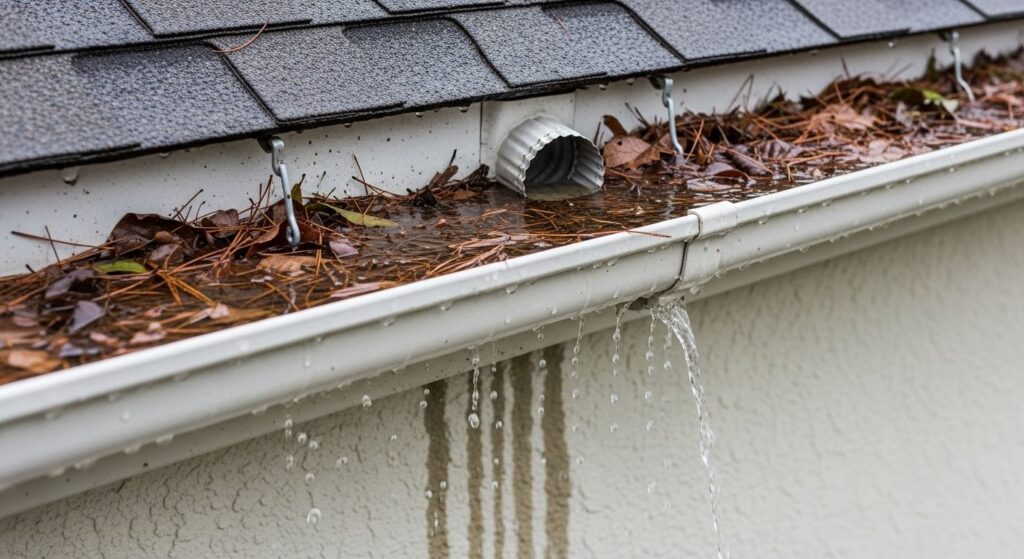
This is the single most common cause of overflow. Leaves, pine needles, roof moss debris, asphalt shingle grit, and general buildup collect in the gutter trough over time. The accumulation narrows the channel and blocks the downspout inlet. During moderate to heavy rainfall, water backs up in the trough and spills over the front edge, pouring directly onto the EIFS wall below.
Downspout elbow clogs are just as dangerous. Many Central Indiana homes have two or three 90-degree elbows between the gutter outlet and the ground-level discharge. Leaves, shingle granules, and roof granules in gutters collect at every bend. A single blocked elbow can cause the entire downspout to back up and overflow at the gutter outlet, dumping a concentrated stream of water onto the EIFS surface at one of the most vulnerable points on the wall.
Seasonal patterns in Indiana: Spring brings seed pods and pollen. Summer storms knock down small branches. Fall drops massive volumes of maple leaves and oak debris. Winter brings ice in gutters and frozen downspouts. Homeowners who only clean gutters once a year almost always have overflow problems during at least two seasons.
Undersized Gutters and Downspouts
Many production-built homes in the Indianapolis metro area, particularly in Fishers, Carmel, and Zionsville, were built with standard 5-inch K-style gutters and 2×3-inch downspouts. For moderate roof areas, these work fine. But on homes with steep roof pitches, large roof valleys, or long gutter runs, a 5-inch gutter simply cannot handle the roof runoff volume during heavy Indiana thunderstorms.
The math is straightforward. A 5-inch K-style gutter handles roughly 5,500 square feet of roof drainage area per downspout in moderate rainfall. Push that to a heavy Indiana downpour (2+ inches per hour), and the effective capacity drops by half or more. Homes that need 6-inch K-style gutters or additional downspouts but have 5-inch systems installed will overflow every time it rains hard, regardless of how clean the gutters are.
Incorrect Gutter Slope (Pitch)
Gutters are supposed to slope toward each downspout at roughly 1/4 inch per 10 feet of run. This keeps water flowing and prevents standing water in the gutter trough. Over time, gutter hangers loosen, fascia boards soften, and the gutter sags at various points. Standing water collects in the low spots. Even a modest rain can cause these pooled areas to overflow.
Sagging is especially common on longer runs (20+ feet without a downspout outlet). Homes with hidden gutter hangers that are spaced too far apart (every 36 inches instead of every 24 inches) are particularly prone to gutter sagging.
Gutter Separation from Fascia
As fascia boards deteriorate (often from the very overflow water the homeowner does not know about), the gutter pulls away from the house. This creates a gap between the back edge of the gutter and the fascia. Water runs off the roof, overshoots the gutter, and flows behind it, directly down the top of the EIFS wall.
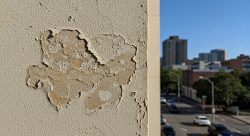
This is one of the hardest overflow paths to spot from the ground. The water is not visible spilling over the front of the gutter. Instead, it is running down the back side, behind the gutter, and straight onto the wall. Homeowners often do not realize this is happening until they notice water stains on the EIFS surface or, worse, interior drywall staining or interior paint bubbling on an upstairs wall.
Gutter Seam, Miter, and End Cap Leaks
Most sectional aluminum gutter systems have seams every 10 to 20 feet, plus miter joints at corners and end caps at termination points. These joints are sealed with gutter sealant during installation, but sealant deteriorates over 5 to 10 years. Once a gutter seam leak or gutter miter leak opens up, water drips steadily onto the same spot on the EIFS wall below, every single time it rains.
Small, steady drips may not seem like a big deal. But consider that this same exact spot on the wall absorbs water during every rain event for months or years. The repeated wetting cycle causes localized damage that is disproportionate to the size of the leak.
Ice Dams and Frozen Downspouts
Central Indiana winters bring freeze-thaw cycling that creates ice dams at eaves and freezes water inside downspouts. When a downspout freezes solid, the entire gutter system above it becomes a trough with no outlet. The next warm-up or rain event fills the trough, and it overflows along the entire length of the gutter run.
Ice dams at eaves are also a concern. Snow melts from the warmer sections of the roof, flows to the colder eave edge, and refreezes. The dam blocks normal water flow into the gutter. Meltwater backs up under shingles and can also cascade over the face of the ice dam, down the fascia, and onto the EIFS wall below. For specific guidance on cold-weather EIFS care, see Indiana Wall Systems’ article on winterproofing EIFS for cold weather repairs and care.
Gutter Guards That Create False Security
Gutter guards, including micro-mesh gutter guards, gutter screens, and leaf guards, reduce the volume of debris entering the trough. They do not eliminate maintenance. Pine needles, shingle grit buildup, and fine organic matter still accumulate on top of and under guards. Many homeowners install guards and then stop inspecting their gutters entirely, assuming the problem is solved. Years later, the guards are clogged, water is sheeting off the top of the guard instead of entering the gutter, and the EIFS wall below has significant water damage.
How Gutter Overflow Damages EIFS: The Failure Path
Understanding exactly how water moves from an overflowing gutter into the EIFS wall assembly is critical for both diagnosing damage and choosing the right repair approach.
Step 1: Water Cascades Down the Cladding
When a gutter overflows, water spills over the front lip or runs behind the gutter along the fascia. Either way, it ends up flowing down the face (or the top edge) of the EIFS wall below. This is bulk water intrusion at its worst: not incidental moisture from wind-driven rain, but concentrated roof runoff volume hitting the same wall sections repeatedly.
Step 2: Water Finds Entry Points
As the water cascades down the cladding, it follows gravity and surface tension along the EIFS surface until it reaches an entry point. The most common entry points include:
- Open or cracked caulk joints at windows, doors, penetrations, and termination points
- Hairline cracks and crazing cracks in the lamina, often at stress points around windows and corners
- Sealant joint failure at expansion joints, control joints, and movement joints where old sealant has pulled away from the EIFS surface
- Mesh overlap failures and mesh fishmouths where the fiberglass mesh was not properly embedded during the original installation
- Missing backer rod or wrong backer rod size in sealant joints, causing three-sided adhesion that cracks under thermal movement
- Decorative foam trim water traps and band trim water traps where horizontal surfaces collect water against vertical EIFS surfaces
Step 3: Water Enters the Wall Cavity
Once past the lamina and base coat, water reaches the insulation board. In older barrier EIFS systems, the water sits directly against the wall sheathing (typically OSB, which swells rapidly when wet, or plywood, which delaminates over time). In drainage EIFS systems with a drainage mat or grooved EPS insulation, some water can weep to the base via the drainage layer and exit through weep holes or a weep screed. But heavy, repeated overflow overwhelms the drainage capacity. Water accumulates faster than it can drain.
Step 4: Trapped Moisture Behind EIFS Begins Destroying the Wall
This is where the real damage happens. The EIFS acts as a vapor-retarder on the exterior side. Moisture that gets behind the system dries very slowly, especially in Indiana’s humid summer months when the dew point in the wall assembly keeps the sheathing wet for weeks at a time.
WHAT HAPPENS OVER TIME:

This progression happens faster in older EIFS systems without a drainage plane. On barrier EIFS homes in Carmel, Fishers, the Village of WestClay, and other established neighborhoods, Indiana Wall Systems has seen structural damage develop in as little as 12 to 18 months from gutter overflow that went unaddressed.
Where Gutter Overflow Hits EIFS Walls Hardest
Gutter overflow does not distribute water evenly across a wall. It concentrates at specific, predictable locations. Knowing these hot spots helps homeowners and inspectors focus their attention where damage is most likely to develop.
Below Gutter Corners and Miters
Outside corners of gutter runs, where two sections meet at a miter joint, are a frequent overflow point. Water backs up at the change in direction and spills over the edge. The EIFS wall directly below a gutter miter joint often shows the earliest signs of water streaking patterns and deterioration.
At and Around Downspout Outlets
Ironically, the area around a downspout is one of the most vulnerable spots on an EIFS home. When the downspout clogs (at the inlet, at an elbow, or underground), the full volume of water that is supposed to drain through that downspout instead overflows right at the outlet. A single clogged downspout can dump more water onto one concentrated section of EIFS wall than the rest of the gutter run combined.
Window Heads Below the Gutter Line
Windows positioned below the gutter line receive overflow water that flows down the wall and collects at the window head flashing (or the lack of it). If there is no proper drip cap over the window, water pools on the window head return and wicks behind the EIFS at the top of the window frame. This is one of the most common locations for hidden moisture damage around windows on EIFS homes.
Band Trim and Decorative Foam Elements
Many EIFS homes feature horizontal band trim, belly bands, and decorative foam shapes (cornices, keystones, quoins). These elements create flat or near-flat surfaces that collect water as it runs down the wall. The joints between decorative elements and the main EIFS field are sealed with caulk, but that caulk is constantly stressed by the pooling water. Once the sealant fails, water penetrates behind the foam trim and into the wall assembly.
Jeff Johnson puts it plainly: “Every EIFS home with foam trim under a gutter overflow spot ends up with a water trap. It is just a matter of time before the sealant gives out and water gets behind it.”
Termination Points at Grade
The bottom of an EIFS wall, where the cladding terminates near ground level, is the final collection point for all the water running down the wall face. If the grade clearance at EIFS is less than the recommended minimum (typically 6 to 8 inches above finished grade per building code), or if mulch is piled against the EIFS, overflow water that runs down the wall face pools at the base and wicks back up into the system through capillary action.
Splashback at grade from downspout discharge also contributes. If downspout extensions are missing, short, or aimed toward the EIFS wall instead of away from it, every rain event splashes water back onto the lower wall.
Inspection Clues: How to Spot Gutter Overflow Damage on EIFS
Professional EIFS inspections that include the gutter system catch overflow damage early. But homeowners can also learn to recognize the visual warning signs. Here are the telltale clues that gutter overflow is causing damage.
Water Stain Lines Below Gutter Edges
The most obvious sign is a horizontal or diagonal stain line on the EIFS surface, running along the path of the overflow. These lines often appear as darkened streaks directly below the gutter lip, especially below sagging sections or at gutter corners. After the wall dries, the stains remain as a slightly different shade or as visible mineral deposits (efflorescence) on the surface.
Algae Growth and Biofilm Streaks
Sections of EIFS wall that stay damp longer than surrounding areas develop algae growth on walls and green or black biofilm streaks. These biological growths need consistent moisture to establish. If you notice algae or biofilm concentrated in vertical streaks below the gutter line but not on other parts of the wall, gutter overflow is the likely moisture source.
Soft Spots and Bulging EIFS
When water accumulates behind the EIFS insulation board, the board can deform. Pressing firmly on the EIFS surface with the heel of your hand may reveal soft spots (areas that yield instead of feeling firm). In more advanced cases, the lamina may visibly bulge outward. Both are signs that the insulation board is saturated and possibly that the sheathing behind it is beginning to deteriorate. Indiana Wall Systems’ article on what it means when EIFS feels soft to the touch explains this indicator in detail.
Hollow-Sounding EIFS
Tap the EIFS surface near a suspected overflow area with your knuckle. A solid EIFS installation produces a dull, muted sound (the insulation board absorbs the impact). If you hear a hollow or drum-like sound, the insulation board has likely delaminated from the substrate, meaning water has broken the adhesive bond and created a gap.
Interior Warning Signs
Sometimes the first clue is not on the exterior at all. Homeowners notice:
- Interior drywall staining on walls or ceilings near the roof line
- Interior paint bubbling or peeling, especially on upper-story walls
- Buckling baseboards on exterior walls
- Mold at window trim on the interior side
- Musty odor indoors in rooms adjacent to the affected exterior wall
- Elevated moisture meter readings if a home inspector or contractor checks the wall

If any of these signs appear on a wall that sits below a gutter run, gutter overflow should be the first suspect.
What a Professional EIFS Inspection Looks For
A full EIFS inspection from experienced contractors goes well beyond a visual scan. Professional tools and techniques include:
- Pin-type moisture meters and capacitance moisture meters inserted at multiple test points around windows, below gutters, and at termination points
- Infrared thermography (thermal camera scans) to identify moisture concentrations behind the cladding without opening the wall
- Borescope inspection through small probe holes to visually examine the condition of sheathing and framing inside the wall cavity
- Probe testing and, in severe cases, destructive test cuts to confirm damage extent
- Assessment of the gutter system itself: slope, capacity, hanger condition, seam integrity, downspout function, and discharge path
Indiana Wall Systems performs EIFS moisture inspections across Indianapolis, Hamilton County, Marion County, and the surrounding Central Indiana service area. Combining wall testing with gutter system evaluation is the only way to accurately diagnose overflow-related damage.
Why EIFS Repairs Fail When Gutters Are Ignored
This is possibly the most important section of this entire article. Indiana Wall Systems sees it repeatedly: a homeowner pays for an EIFS patch, and within a year or two the same area fails again. The pattern is frustrating, expensive, and entirely avoidable.
The Repair-Fail-Repeat Cycle
Here is how the cycle typically plays out:
- Homeowner notices damage. Cracking, staining, or soft spots appear on the EIFS surface below a gutter run.
- Contractor patches the EIFS. The damaged lamina and base coat are removed, the insulation board is replaced (if visibly deteriorated), new mesh is embedded, and a new finish coat is applied. The patch looks great.
- No one addresses the gutter. The contractor was not asked to evaluate the gutter system. The homeowner was not told it mattered. The gutter continues to overflow during every heavy rain.
- Water returns to the same wall section. Within months, water is again cascading down the wall from the same overflowing gutter, entering the same vulnerable joints and cracks.
- The new patch fails. Sometimes faster than the original, because the new sealant joints are fresh and tight but the volume of water is relentless.
What a Proper Repair Sequence Looks Like
Fixing gutter-overflow EIFS damage requires addressing the water source first, then repairing the wall. The correct sequence is:
- Diagnose and fix the gutter system before any EIFS work begins. This may include cleaning, re-hanging, re-sloping, upsizing, adding downspouts, sealing seams, or replacing damaged sections.
- Perform a full moisture assessment of the affected wall sections to determine the extent of hidden damage.
- Open the wall where moisture readings are elevated. Remove EIFS and inspect the sheathing, framing, and insulation.
- Replace all damaged materials. This includes swollen OSB, delaminated plywood, rotted studs, rotted rim joists, and saturated cavity insulation. Half-measures here lead to future mold problems.
- Rebuild the EIFS with proper drainage details, including a water-resistive barrier, drainage mat or grooved EPS, weep tracks, and properly lapped flashing at all transitions.
- Re-inspect the gutter system after EIFS repair to verify that water flow and discharge are correct.
Skipping step one, the gutter fix, makes every subsequent step a waste of time and money.
Gutter Fixes That Protect EIFS Walls
Once a gutter system has been identified as the source of overflow damage, the fix depends on the specific problem. Below is a breakdown of the most common gutter-related corrections Indiana Wall Systems recommends (and often coordinates with gutter specialists to complete).
Regular Gutter Cleaning
The simplest and cheapest preventive measure. Gutters and downspouts should be cleaned at least twice a year, ideally in spring and fall. Homes surrounded by heavy tree canopy (especially pin oaks, maples, and pine trees common throughout Central Indiana neighborhoods) may need cleaning three or four times per year.
What to clean:
- Full gutter trough, end to end
- Downspout inlets (where the trough meets the downspout)
- All downspout elbows (disconnect and flush if clogged)
- Underground downspout drain lines (flush with a garden hose; if a clogged underground leader is suspected, have it snaked or replaced)
Correcting Gutter Slope
If standing water in the gutter trough is visible during dry weather, the gutter pitch needs correction. A qualified installer can re-hang gutters with proper slope (1/4 inch per 10 feet toward the downspout). For long runs, installing a second downspout at the midpoint eliminates the need for excessive slope and reduces the water volume that any single downspout must handle.
Resizing Gutters and Downspouts
Homes with oversized roofs, steep pitches, or multiple roof valleys feeding into a single gutter run may need to upgrade from 5-inch to 6-inch K-style gutters and from 2×3-inch to 3×4-inch downspouts. This is especially common in newer subdivisions across Hamilton County and Boone County where homes have complex roof lines.
Quick sizing guide:
Adding Downspouts
Sometimes the gutter size is adequate, but the spacing between downspouts is too far apart. The general rule is one downspout for every 20 to 30 linear feet of gutter run. If a 50-foot gutter run has only one downspout at one end, adding a second downspout at the opposite end (or at the midpoint) can eliminate overflow issues entirely.
Re-sealing Gutter Joints
Gutter seam leaks, gutter miter leaks, and gutter end cap leaks are fixed by cleaning the joint, removing old sealant, and applying a high-quality gutter sealant. This is a low-cost repair that can prevent years of concentrated drip damage to the EIFS surface below.
Replacing Fascia and Soffit
When gutter overflow has been ongoing for years, the fascia board underneath the gutter is often rotted. Soft or rotted fascia cannot hold gutter hangers, leading to gutter sagging and separation from the house. Replacing the fascia (and any damaged soffit) before re-hanging the gutter is essential. Skipping this step means the new gutter will sag and separate again within a few years.
Ensuring Proper Downspout Discharge
Getting water into and through the gutter system is only half the battle. Where the water goes after it leaves the downspout matters just as much. Key practices include:
- Downspout extensions that carry water at least 4 to 6 feet away from the foundation
- Splash blocks at the discharge point to prevent soil erosion at the downspout
- Connecting to underground downspout drain lines that discharge to daylight, away from the house
- Checking for negative grading (soil that slopes toward the house instead of away) and correcting it
- Avoiding downspout discharge at the foundation wall, which causes basement seepage from downspouts and foundation washout
For EIFS homes specifically, downspout discharge should also direct water away from the lower sections of the EIFS wall to prevent splashback at grade.
The Gutter-to-EIFS Connection Points You Cannot Ignore
Certain areas where the gutter system physically meets or interacts with the EIFS cladding require special attention during both installation and maintenance.
Fascia-to-EIFS Transition
The top edge of the EIFS wall typically terminates at or near the fascia board. How this transition is detailed determines whether overflow water can reach the wall assembly. Proper installations include cap flashing at the EIFS termination that directs water away from the wall face. Improper installations leave a gap or rely solely on caulk, which fails over time.
Drip Edge and Gutter Alignment
A properly installed drip edge at the roof’s eave directs water from the shingles into the gutter trough. If the shingle overhang into the gutter is too short, water can drip behind the gutter and run down the fascia onto the EIFS. If the drip edge gap at fascia is too large, the same problem occurs.
Correct alignment means:
- Shingles extend 1/2 to 3/4 inch past the fascia
- Drip edge directs water into the gutter, not behind it
- No gap between the back edge of the gutter and the fascia/drip edge
Roof Valley Runoff Into Gutter
Roof valleys concentrate runoff from two roof planes into a single channel. The volume of water exiting a valley during heavy rainfall can be three to five times the volume of water from a comparable length of straight eave. If the gutter section receiving that valley runoff is not sized accordingly (or if the downspout below is undersized), overflow at valleys is guaranteed during any significant rain event.
Chimney Cricket and Dormer Sidewall Intersections
Where a chimney or dormer meets the main roof, a cricket or diverter is supposed to redirect water around the obstruction and into the gutter system. Improperly built or missing crickets send concentrated water flow into the gutter at high velocity, which can overwhelm the gutter capacity at that point. The EIFS wall below these intersections is a frequent site of dormer sidewall leaks and hidden damage.
Landscaping and Site Drainage: The Ground-Level Factor
Gutter overflow is a roof-level problem, but its effects extend to ground level. Site drainage and landscaping choices around an EIFS home either help manage overflow water or make the problem worse.
Mulch Against EIFS
Piling mulch against the base of an EIFS wall holds moisture against the cladding and reduces the critical grade clearance at EIFS. Building code and manufacturer guidelines typically require a minimum of 6 inches of clearance between the bottom of the EIFS and finished grade. Mulch reduces this gap, traps moisture, and invites insects. If overflow water is running down the wall and pooling at the base, mulch turns the lower wall into a constant moisture source.
Sprinkler and Irrigation Overspray
Sprinkler overspray onto EIFS and irrigation misting on walls add unnecessary moisture to the EIFS surface on a regular schedule. When combined with gutter overflow, the wall never gets a chance to dry out. Adjusting sprinkler heads so they spray away from the EIFS walls is a simple fix that makes a real difference.
Negative Grading and Poor Site Drainage
If the ground around the home slopes toward the foundation instead of away from it, both gutter discharge and surface runoff collect at the base of the EIFS wall. This creates a double moisture source: overflow from above and standing water from below. Proper drainage requires a minimum slope of 6 inches of fall over the first 10 feet away from the foundation on all sides of the home.
For broader guidance on protecting EIFS from ground-level threats, see Indiana Wall Systems’ post on protecting EIFS walls from landscaping and irrigation damage.
Seasonal Gutter Maintenance Schedule for EIFS Homeowners
Consistent, scheduled gutter maintenance is the cheapest form of EIFS damage prevention. Below is a practical schedule tailored to Central Indiana’s climate and seasonal patterns.
Spring (March Through May)
- Clean all gutters and downspouts of winter debris, ice residue, and accumulated grit
- Check for loose gutter hangers and sagging sections after winter freeze-thaw cycling
- Inspect gutter seams, miters, and end caps for leaks
- Flush underground downspout drain lines to confirm they are clear
- Inspect EIFS walls below all gutter runs for new staining, algae, or soft spots
- Check grade clearance at EIFS base
Summer (June Through August)
- Monitor gutters during heavy thunderstorms for overflow at corners, valleys, and downspout outlets
- Note any overflow at valleys or overflow at downspouts for correction before fall
- Check for tree growth that has expanded canopy coverage over the roof since last year
- Inspect sealant joints on EIFS walls near gutter areas for signs of deterioration
Fall (September Through November)
- Clean gutters and downspouts after the majority of leaves have dropped (typically late October to mid-November in Central Indiana)
- If heavy tree canopy is present, schedule a second cleaning in early December
- Verify downspout extensions and splash blocks are in place before winter
- Check for any gutter separation from fascia that developed during the warm months
Winter (December Through February)
- After major ice or snow events, check for ice dams at eaves and frozen downspouts
- Do not attempt to break ice dams mechanically (this damages shingles and gutters)
- If persistent ice damming occurs, plan for heated cable installation or improved attic ventilation before the next winter
- Watch for signs of snowmelt overflow at warmer sections of the roof
Gutter Overflow vs. Flashing Failure: Knowing the Difference
Homeowners (and sometimes less experienced contractors) often confuse gutter-overflow damage with flashing failure. Both can produce staining and moisture behind the EIFS, but the damage patterns are different, and the fixes are different.
Both issues can (and often do) exist simultaneously on the same home. A proper professional EIFS inspection evaluates both the gutter system and the flashing details to identify every moisture source before repair work begins.
The Real Cost of Ignoring Gutter Overflow on EIFS
Financial consequences escalate rapidly the longer gutter overflow goes unaddressed. Here is a general cost comparison (Central Indiana market, 2025/2026 typical ranges):
The gap between $300/year for gutter cleaning and $15,000+ for sheathing replacement is enormous. Every dollar spent on gutter maintenance prevents costly repairs down the line.
When to Call Indiana Wall Systems
Not every gutter overflow situation requires a full EIFS restoration. But certain warning signs mean it is time to call a qualified EIFS contractor for an inspection.
Call if you notice any of these on your EIFS home:
- Persistent water stains below gutter runs that return after cleaning the wall
- Soft spots anywhere on the EIFS surface
- Visible bulging or delamination of the EIFS lamina
- Algae or biofilm streaks that only appear below gutters or at corners
- Interior staining, paint bubbling, or musty odors on walls adjacent to the exterior
- A gutter system that consistently overflows during moderate rain, even after cleaning
- A previous EIFS repair in the same area that has failed again
Indiana Wall Systems serves homeowners, property managers, and commercial building owners throughout Central Indiana, including Carmel, Fishers, Zionsville, Indianapolis, Greenwood, Plainfield, Avon, Speedway, and surrounding communities. With over 26 years of hands-on experience in EIFS repair, inspection, and restoration, the team understands that fixing the wall without fixing the water source is a temporary patch, not a lasting repair.
Frequently Asked Questions
How often should gutters be cleaned on an EIFS home?
Gutters on an EIFS home should be cleaned at least twice per year, once in spring and once in late fall. Homes with heavy tree canopy overhead may need three or four cleanings annually. Regular gutter cleaning is one of the most effective ways to prevent costly water damage to EIFS walls.
Can gutter overflow damage EIFS even if the cladding looks fine on the surface?
Yes. Gutter overflow frequently causes hidden damage behind the EIFS surface long before visible signs appear on the exterior. Water enters through small cracks, open sealant joints, or mesh imperfections and soaks the insulation board and sheathing. A professional moisture inspection using pin-type moisture meters or infrared thermography can reveal damage that is invisible to the eye.
What size gutters should an EIFS home in Indiana have?
Most standard Indiana homes do well with 5-inch K-style gutters and 2×3-inch downspouts, provided downspouts are spaced every 20 to 30 linear feet. Homes with steep roofs, large roof valleys, or long gutter runs should upgrade to 6-inch K-style gutters with 3×4-inch downspouts to handle heavy rainfall.
Will gutter guards prevent overflow damage on EIFS walls?
Gutter guards reduce the amount of large debris entering the gutter trough, but they do not eliminate the need for maintenance. Fine debris, shingle grit, and organic matter still accumulate over time. Guards that are not maintained can actually cause worse overflow because water sheets off the clogged guard surface instead of entering the trough.
How can I tell if my EIFS damage is from gutter overflow or a flashing problem?
Gutter overflow damage typically appears as vertical water stain lines or algae streaks running down the wall below the gutter edge. The affected area is often wide and follows the gutter run. Flashing failure damage tends to be concentrated at specific roof-to-wall transitions or penetrations. A qualified EIFS inspector can determine the exact moisture source using moisture meters and thermal imaging. See the comparison table above for a side-by-side breakdown.
Does Indiana Wall Systems fix gutters, or just the EIFS?
Indiana Wall Systems specializes in EIFS repair, restoration, and inspection. The team identifies gutter overflow as a moisture source during inspections and coordinates with qualified gutter professionals to ensure the water problem is corrected before EIFS repair begins. This approach stops the repair-fail-repeat cycle that wastes homeowners’ money.
What does a professional EIFS moisture inspection cost?
Inspection costs vary depending on the size of the home and the scope of testing required. Indiana Wall Systems offers inspections across the Central Indiana service area. Call (765) 341-6020 for a consultation and to discuss the specific situation for your property.
Key Insights
- Gutter overflow is a leading cause of repeat EIFS failure in Central Indiana. The damage path (overflowing trough to cascading water to entry through cracks and joints to trapped moisture behind the wall) follows the same pattern on hundreds of homes Indiana Wall Systems has inspected over 26 years.
- Fixing the EIFS without fixing the gutter is the single most common reason EIFS repairs fail within one to three years. The gutter system must be corrected first.
- Older barrier EIFS homes (built before the early 2000s) are at the highest risk because water that gets behind the system has no drainage path and no way to dry.
- Visual warning signs (stain lines below gutters, algae streaking, soft spots, interior moisture symptoms) should prompt a professional EIFS inspection that includes the gutter system.
- Preventive gutter maintenance (cleaning twice a year, correcting slope, sealing joints, ensuring proper downspout discharge) costs a fraction of what wall damage repair costs and eliminates the primary moisture source.
- Indiana Wall Systems serves homeowners and commercial property owners across Hamilton County, Marion County, Johnson County, Hendricks County, Boone County, and surrounding areas with EIFS inspection, repair, and restoration services. Call (765) 341-6020 to schedule a free estimate.