
Why Spring Is the Best Time to Catch Leaks Where Brick Meets EIFS
Mixed-material facades are common across Central Indiana. Brick veneer on the lower portion of a building paired with EIFS (Exterior Insulation and Finish System) above is one of the most popular combinations on homes, HOA communities, and commercial properties in the Indianapolis area. The look is sharp, and when detailed correctly, it performs well for decades. But the joint where these two materials meet is one of the most failure-prone areas on any facade. If mortar joints are cracking, sealant is pulling away, or staining is showing up below the transition, spring is the right time to take a closer look. Indiana Wall Systems provides brick restoration and tuck-pointing services across Central Indiana and has spent more than 26 years evaluating and repairing exactly these types of conditions.
The area where brick meets EIFS is a dissimilar-material transition joint that is especially vulnerable to leaks. Failed mortar joints, deteriorated sealant, and poor flashing details at this transition allow water to enter the wall assembly. Spring is the best time to spot these problems because winter freeze-thaw cycles widen cracks and push staining, efflorescence, and joint separation into view. Catching these signs early can prevent hidden moisture damage behind the facade.
Spring is the season when hidden problems become visible. Months of freeze-thaw cycling stress mortar joints, pull sealant away from substrates, and push moisture through small cracks that may not have been obvious in fall. The staining, white salt deposits, and separated joints that show up in March through May are often signs of a longer pattern of water entry. This article walks through why these transition areas fail, what to look for during a spring walkthrough, and how to think about the repair scope when the damage extends beyond just the brick or just the EIFS.
| 1 | The brick-to-EIFS transition is not just an appearance joint. It is part of the wall’s water-management system, and failure here lets moisture into the building envelope. |
| 2 | Spring reveals damage that winter created. Freeze-thaw cycles widen cracks, weaken mortar, and push staining and efflorescence into view. |
| 3 | Mortar-joint failure and sealant-joint failure are different problems that often occur together at the same transition. Fixing only one may leave the other as an active leak path. |
| 4 | Staining or soft spots on the EIFS near the transition may indicate that moisture has already traveled behind the surface. The visible symptom is often not the full story. |
| 5 | Tuckpointing alone may not be enough if the sealant joint, flashing, or EIFS lamina at the transition has also failed. A proper repair scope accounts for all the weak points, not just the most visible one. |
Why Spring Exposes Problems Where Brick Meets EIFS
Indiana’s winters deliver the exact conditions that accelerate damage at material transitions. Temperatures in the Indianapolis area regularly swing above and below freezing between November and March. Each time water enters a mortar joint, a sealant gap, or a hairline crack and then freezes, it expands by roughly 9%. That expansion presses outward against the surrounding material, widening the opening slightly. When the ice melts, more water enters. The cycle repeats, and each round leaves the joint a little weaker.
By the time spring arrives, the cumulative effect of dozens of freeze-thaw cycles becomes visible. Mortar that looked stable in October may now be recessed, crumbling, or cracked. Sealant that was already aging may have pulled free from one or both substrates. Staining below the transition, caused by water carrying dissolved salts through the masonry, shows up as white powdery deposits (efflorescence) or dark streaks on the brick face.
Spring rains then test those weakened areas. Water hits a facade that has been softened by winter and finds the paths of least resistance. For property owners and managers, this is the window when problems are easiest to see and diagnose. Waiting until summer or fall means those same symptoms may dry out and become less obvious, even though the underlying damage has not gone away.
What Makes the Transition Zone So Vulnerable
The brick-to-EIFS transition is not a simple seam. It brings together two materials that behave very differently:
- Brick veneer absorbs and releases moisture slowly. It expands and contracts at a rate driven by temperature and moisture content.
- EIFS is a layered system with a rigid insulation core, a thin reinforced base coat, and a flexible acrylic finish. It moves differently from brick as temperatures change.
- Mortar joints in the brick deteriorate over time through weathering, freeze-thaw stress, and carbonation.
- Sealant joints at the transition are designed to bridge the gap between dissimilar materials, but they lose elasticity, bond strength, and continuity as they age.
When these materials are joined at a transition, each one moves at its own rate. The sealant joint between them must absorb that differential movement without losing its seal. Over years of weather exposure, especially in a climate like Central Indiana’s, even well-installed joints can reach the end of their service life.
Poor original detailing makes the problem worse. If the flashing at the transition was not properly lapped or terminated, if the sealant joint was too narrow for the expected movement, or if the drainage path behind the materials is incomplete, water entry at this joint was only a matter of time.
Where Brick-to-EIFS Transitions Commonly Fail
Not every transition fails in the same way. The location of the joint on the building, nearby penetrations, and the original construction details all play a role. Here are the most common failure locations on mixed-material facades.
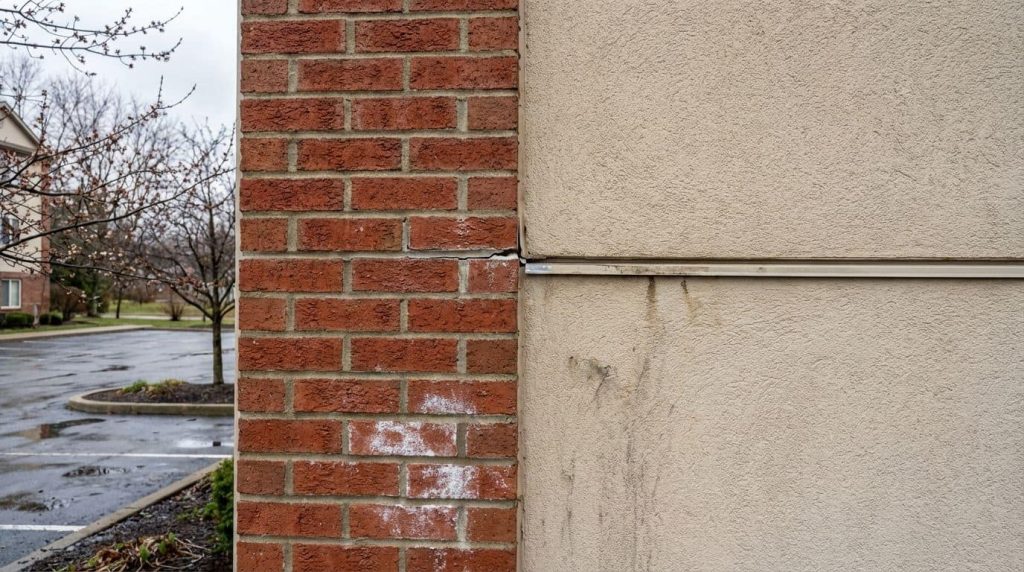
Vertical Transitions
The most common arrangement in Central Indiana is brick on the lower portion of the wall with EIFS above. The vertical or near-vertical joint where these two materials meet runs the length of the facade and is exposed to rain, wind, and temperature swings along its entire length. Sealant failure here is one of the most frequent issues Indiana Wall Systems identifies during spring inspections.
Horizontal Shelf or Offset Conditions
Some designs include a shelf angle or horizontal offset where brick meets EIFS at a floor line or band detail. These areas collect water that runs down the wall above, and any failure in the flashing or sealant at this point directs moisture into the wall assembly.
Window and Door Surrounds
Areas where brick returns into EIFS around windows and doors create multiple transition joints in a small area. Head, jamb, and sill conditions all involve changes in material. Water that enters at any one of these joints can travel along the interface and show up somewhere else entirely. Understanding how to read an EIFS inspection report helps property owners evaluate what an inspector finds at these areas.
Near Roof Lines and Gutter Runoff
Transitions near roof-to-wall intersections are especially exposed. If the kickout flashing is missing, undersized, or improperly integrated with the cladding, concentrated roof runoff can sheet down the wall and enter at the brick-to-EIFS joint. Gutter overflow from clogged or undersized gutters creates a similar problem. Indiana Wall Systems has written about how gutter overflow causes hidden wall damage in EIFS, and the risk is even higher when brick is part of the assembly.
Near Grade
Splash-back from rain hitting the ground, snowmelt, and irrigation can saturate the lower portion of any wall. If the brick-to-EIFS transition is close to grade, or if the EIFS terminates near grade without proper clearance and flashing, moisture entry from below adds to whatever is coming in from above.
Leak Red Flags to Watch For
A spring walkthrough does not require specialized equipment. Many of the most important warning signs are visible from the ground with nothing more than a close look and good light. Here is what to watch for at and near the brick-to-EIFS transition.
Cracked or Eroded Mortar Joints
Mortar joints that are recessed, crumbling, or showing open cracks near the transition are direct water entry points. Pay close attention to joints within a few courses of the transition line. Mortar that is recessed more than 1/4 inch from the brick face generally needs attention.
Separated or Failed Sealant Joints
Look at the sealant where brick meets EIFS. If it has pulled away from either surface, cracked through the middle, turned hard and brittle, or shows visible gaps, it is no longer keeping water out. Sealant failure at this location is one of the most common and most consequential issues on mixed-material facades.
Gaps at the Transition
Any visible gap where brick and EIFS meet, with no intact sealant bridging the space, is an open path for water. Even small gaps can admit significant amounts of water during wind-driven rain.
Staining Below the Transition
Dark streaks or discoloration on the brick face below the joint suggest that water has been running down behind or along the transition. The staining may be seasonal, becoming more obvious after rain or snowmelt and fading during dry weather.
Efflorescence
White, powdery or crystalline deposits on the brick surface near the transition are a sign that water has been moving through the masonry and carrying dissolved salts to the surface. Efflorescence is not harmful on its own, but it is a reliable indicator that moisture is getting into the wall. It often becomes more visible in spring after the thaw.
Soft or Damaged EIFS Near the Joint
If the EIFS feels soft or spongy when pressed near the transition, moisture may have reached the insulation layer beneath the lamina. This is a sign that water has moved past the outer shell and into the wall system. Soft EIFS near a transition joint typically calls for further evaluation. Indiana Wall Systems’ guide on EIFS water damage repair covers what that process looks like in detail.
Peeling, Bubbling, or Discolored Finish Coat
Paint or finish coat deterioration on the EIFS near the transition can indicate that moisture is trapped behind the surface layer. Bubbling, peeling, or areas where the finish has changed color often point to a moisture problem behind the visible surface.
Recurring Damp Spots After Rain
If certain areas near the transition remain damp longer than the surrounding wall after a rain event, it may mean that water is entering and saturating the substrate or insulation at that location.
Patchy Prior Repairs
Look for areas where previous caulking, patching, or tuckpointing has been done near the transition. Repeated or patchy repairs in the same location often mean the underlying cause of water entry was never fully addressed.
Mortar-Joint Problems vs. Sealant-Joint Problems
One of the most important distinctions in diagnosing leaks at a brick-to-EIFS transition is understanding the difference between mortar-joint failure and sealant-joint failure. They are not the same thing, and confusing them leads to incomplete repairs.
Mortar-Joint Failure
Mortar joints hold bricks together and are designed to resist water entry across the face of the masonry. Over time, mortar weathers, erodes, and can crack due to freeze-thaw stress, building settlement, or simply age. When mortar joints fail near the transition, water enters the brick portion of the wall and can migrate laterally or downward toward the EIFS.

Tuckpointing (sometimes called repointing) is the standard repair for failed mortar joints. It involves removing the damaged mortar to a proper depth and replacing it with fresh mortar that matches the original in composition, color, and profile. For more detail on the difference between tuckpointing and repointing, Indiana Wall Systems has a full breakdown of which brick joint fix saves you money.
Sealant-Joint Failure
The sealant joint at the brick-to-EIFS transition is a different component entirely. This joint is designed to bridge the gap between two dissimilar materials and flex with their differential movement. It is typically a backer rod and sealant (sometimes called an engineered sealant joint), and it requires:
- Proper joint width for the expected movement
- Compatible sealant that bonds to both substrates
- A bond breaker (backer rod) to prevent three-sided adhesion
- Clean, properly prepared surfaces at the time of installation
When this sealant joint fails (through adhesive failure, cohesive failure, or loss of elasticity), water enters at the transition itself, regardless of the condition of the mortar joints nearby.
When Both Fail Together
In many spring inspections, Indiana Wall Systems finds that both the mortar joints and the sealant joint at the transition have deteriorated. This is common because the same environmental forces (freeze-thaw, UV exposure, wind-driven rain) act on both. Fixing only the mortar while leaving failed sealant in place, or recaulking the transition without addressing the crumbling mortar nearby, leaves an active leak path.
| Mortar-Joint Failure | Sealant-Joint Failure | |
|---|---|---|
| Location | Between individual bricks in the masonry field | At the joint where brick meets EIFS |
| Cause | Weathering, freeze-thaw, age, settlement | Loss of elasticity, adhesive or cohesive failure, UV breakdown |
| Visible Signs | Recessed, crumbling, or cracked mortar between bricks | Pulled-away, cracked, or missing sealant at the material change |
| Repair | Tuckpointing (mortar removal and replacement) | Sealant removal, joint prep, backer rod, and new sealant |
| Risk if Ignored | Water enters masonry, travels to adjacent materials | Water enters directly at the transition, can reach sheathing and framing |
How Water Moves at Brick-to-EIFS Transitions
Understanding how water travels at a mixed-material transition is key to diagnosing the source of a leak. The visible stain, soft spot, or damp area is often not where the water first entered. It is where the water ended up after traveling through the wall assembly.
Common Water Pathways
- Through deteriorated mortar joints. Water that enters failed mortar joints near the transition can move laterally along the mortar bed, travel down the back side of the brick veneer, and eventually reach the EIFS or the sheathing behind it.
- Through failed sealant at the transition. When the sealant between brick and EIFS fails, water has a direct path into the gap between dissimilar materials. From there, it can run along the substrate, enter behind the EIFS insulation, or wet the drainage plane (if one exists).
- Behind the EIFS lamina. Water that passes through the outer shell of the EIFS can travel along the back of the insulation board before it shows up as a soft spot or stain, sometimes several feet from the actual entry point.
- Along flashing or poorly terminated edges. Flashing is supposed to redirect water out of the wall assembly. When flashing is missing, too short, improperly lapped, or not integrated with the cladding, it can actually channel water deeper into the wall instead of out.
- Around penetrations near the transition. Windows, doors, utility boxes, light fixtures, and other openings near the brick-to-EIFS transition create additional pathways. If the sealant or flashing around those penetrations has failed, water entry at the penetration can be misread as a transition-joint problem.
- Downward to staining zones. Gravity pulls water down through the assembly, which is why staining and efflorescence often appear below the actual point of entry. The visible symptom may be two or three feet below the joint where water first got in.
Why Visible Symptoms Can Be Misleading
A stain on the brick below the transition does not always mean the mortar joints are the source. The water may have entered at the sealant joint above and run down the back of the brick. Similarly, a soft spot in the EIFS may not mean the EIFS itself failed. The moisture may have entered at the brick-to-EIFS joint and traveled behind the lamina.
This is why spring inspections of mixed-material facades need to account for the full water path, not just the visible symptom. Indiana Wall Systems recommends starting at the top of the affected area and working down, checking each potential entry point along the way.
When Tuckpointing Is Enough (and When It Is Not)
Tuckpointing is a proven and effective repair for deteriorated mortar joints. When the problem is limited to eroded or cracked mortar in the brick field, and the sealant joints, flashing, and adjacent EIFS are still in good condition, tuckpointing may be all that is needed.
When Tuckpointing Alone Can Solve the Problem
- Mortar joints near the transition are visibly cracked or recessed, but the sealant between brick and EIFS is still bonded and flexible.
- There are no signs of moisture damage on the EIFS side of the transition.
- Staining or efflorescence is limited to the brick surface and does not extend to the EIFS.
- Flashing at the transition appears intact.
- There is no history of recurring leaks in the area.
When Tuckpointing Is Not Enough
Tuckpointing alone will not solve the problem in these situations:
- The sealant joint at the transition has failed. Recaulking or replacing the sealant at the material change is a separate repair from tuckpointing the mortar joints, and both need attention.
- The EIFS near the transition is soft, discolored, or damaged. This suggests moisture has already moved behind the EIFS surface and may require cutting back the lamina to inspect the substrate and insulation.
- Staining or moisture symptoms extend to the EIFS side. Water that has crossed from the masonry into the EIFS system means the repair scope needs to include both materials.
- Flashing at the transition is missing, damaged, or improperly integrated. Without functional flashing, newly tuckpointed mortar and fresh sealant will still face water entry from above.
- Roof runoff or gutter overflow is directing water onto the transition. Fixing the joints without addressing the source of concentrated water flow leaves the root cause in place. Understanding the role of kickout flashing for EIFS helps explain why this detail matters so much.
- The problem has recurred after previous masonry-only repairs. Repeated leaks in the same area after tuckpointing strongly suggest there is more going on than mortar-joint failure alone.
⚠ Common Mistake
Hiring a masonry contractor to tuckpoint the brick without also evaluating the sealant joint, flashing, and EIFS condition at the transition can result in a repair that looks complete but leaves active water entry paths in place. When brick and EIFS share a wall, the repair scope should account for both systems.
What a Proper Repair Scope May Need to Include
The right repair scope depends on what the inspection finds. Not every spring issue at a brick-to-EIFS transition needs a major project, but every one needs a clear diagnosis before work starts. Here is what a proper scope may involve, depending on the severity of the problem.
Inspection and Diagnosis
- A close visual review of the entire transition, including areas above, below, and at nearby penetrations
- Evaluation of mortar-joint condition in the brick near the transition
- Assessment of sealant-joint condition where brick meets EIFS
- Checking for soft or damaged areas in the EIFS near the joint
- Review of flashing, terminations, and drainage details if symptoms suggest a wider issue
- Moisture-focused testing when surface symptoms suggest hidden damage behind the cladding
Masonry Repairs
- Tuckpointing failed mortar joints to the proper depth with mortar matched to the original in composition, color, and profile
- Repointing larger sections if deterioration is widespread
- Addressing brick spalling or damage where freeze-thaw has caused face loss
Sealant Repairs
- Full removal of failed sealant at the brick-to-EIFS transition
- Cleaning and preparation of both substrates
- Installation of backer rod to prevent three-sided adhesion
- Application of compatible sealant sized for the expected joint movement
- Inspection and repair of sealant at nearby windows, doors, and penetrations if needed
EIFS Repairs
- Removal of damaged lamina where moisture has compromised the base coat or mesh
- Evaluation of the insulation and substrate behind the damaged area
- Replacement of damaged insulation board and substrate material if warranted
- Application of new base coat, mesh, and finish coat matched to the existing EIFS texture and color
- Indiana Wall Systems’ EIFS repair services cover the full range of these types of conditions
Flashing and Drainage
- Review and correction of flashing at the transition if it is missing, short, or improperly lapped
- Verification that the drainage path behind the cladding is continuous and functional
- Correction of any runoff or gutter issues directing water onto the transition
Repair Sequencing
One of the most important and most overlooked aspects of a mixed-material repair is repair sequencing. The masonry work, sealant work, EIFS repair, and flashing corrections need to happen in the right order to avoid trapping moisture or breaking a new seal during adjacent work. A scope that addresses all the weak points but sequences the work incorrectly can still fail.
Mistakes That Let Leaks Keep Coming Back
When leaks return after a repair at a brick-to-EIFS transition, it usually means the original scope missed something, or the repair did not address the full water path. Here are the most common mistakes that lead to recurring problems.
Fixing Only the Most Visible Symptom
A cracked mortar joint is easy to see and easy to fix. But if the sealant at the transition has also failed, or if flashing above is directing water into the joint, the mortar repair alone will not hold. The visible crack may have been the least important part of the problem.
Patching Mortar Without Checking Adjacent Sealant
Tuckpointing the brick without inspecting the sealant joint a few inches away at the material change is one of the most common oversights. Both are potential water entry points, and both are affected by the same weather exposure.
Sealing Over Dirty or Failed Material
Applying new sealant over old, failed sealant or onto a dirty substrate produces a joint that looks good but does not bond properly. Adhesive failure is almost guaranteed when the joint was not properly cleaned and prepped before the new sealant went in.
Ignoring Runoff or Flashing Problems Nearby
A perfectly executed tuckpointing and sealant repair will still fail if concentrated roof runoff or gutter overflow is dumping water directly onto the transition. The volume of water overwhelms the joint before the sealant can do its job.
Treating the Issue as Purely Brick or Purely EIFS
Calling only a masonry contractor or only an EIFS contractor for a mixed-material transition problem can leave half the issue undiagnosed. The brick side and the EIFS side are part of the same water-management system at the transition, and the repair should reflect that.
Skipping Inspection When Symptoms Suggest Hidden Moisture
Surface repairs to mortar and sealant may look complete, but if moisture has already migrated behind the EIFS or into the sheathing, the hidden damage continues to worsen. When symptoms like soft EIFS, recurring staining, or persistent damp spots are present, skipping a deeper inspection is a gamble.
Overlooking Differential Movement
The joint between brick and EIFS must accommodate the different rates at which these materials expand and contract. If a repair does not account for this movement (for example, using a rigid repair material or an undersized sealant joint), the new work can crack or separate within a few seasons.
Spring Inspection Checklist for Owners and Managers
This checklist is designed for property owners, HOA board members, facility managers, and building managers who want to evaluate their mixed-material facades this spring. It does not replace a professional inspection, but it can help identify areas that warrant closer attention.
| ▢ | Are there open, cracked, or eroded mortar joints within a few courses of the EIFS transition? |
| ▢ | Is the sealant at the brick-to-EIFS joint still bonded to both surfaces and flexible? |
| ▢ | Is there any visible gap where brick meets EIFS with no sealant in place? |
| ▢ | Is there staining, discoloration, or efflorescence on the brick below the transition? |
| ▢ | Does the EIFS feel soft or spongy when pressed near the transition joint? |
| ▢ | Are there windows, doors, or penetrations within 12 inches of the transition that show deteriorated sealant? |
| ▢ | Is there roof runoff, gutter overflow, or downspout discharge hitting the transition area? |
| ▢ | Has this area been repaired or recaulked before? If so, has the problem returned? |
| ▢ | Does the problem appear to be limited to surface deterioration, or could moisture be getting behind the cladding? |
| ▢ | Does the repair scope under consideration address both the masonry and the EIFS-related weak points, or only one side? |

If two or more items on this list apply to the same area, a professional evaluation is a good idea. The more factors that overlap at one location, the higher the likelihood that water has found a path into the wall assembly.
For property owners and managers in Central Indiana who want to understand how often EIFS should be inspected and what to look for each season, Indiana Wall Systems’ guide on EIFS inspection frequency in Indiana covers the full picture.
Frequently Asked Questions
Can tuckpointing fix a leak where brick meets EIFS?
Tuckpointing repairs failed mortar joints in the brick, which is one potential source of water entry. But if the sealant joint at the brick-to-EIFS transition has also failed, or if flashing is missing or damaged, tuckpointing alone will not stop the leak. A proper evaluation should check both the mortar joints and the sealant joint before settling on a repair scope.
What is the white powder on my brick near the EIFS?
The white, chalky, or crystalline deposit is called efflorescence. It forms when water moves through the masonry and carries dissolved mineral salts to the surface. As the water evaporates, it leaves the salts behind. Efflorescence itself does not damage the brick, but it signals that moisture is getting into the wall. Finding and fixing the water source is more important than cleaning the salt deposits.
Why does the EIFS feel soft near where the brick meets it?
Soft EIFS near a transition joint usually means moisture has gotten past the outer lamina and into the insulation layer beneath. This can happen when the sealant joint at the transition fails, when flashing is not directing water out of the wall, or when mortar-joint failure in the brick allows water to migrate laterally into the EIFS system. A closer inspection is needed to determine how far the moisture has traveled.
How often should the sealant at a brick-to-EIFS joint be replaced?
Sealant lifespan depends on the product, joint design, UV exposure, and weather conditions. In Central Indiana, exposed joints often begin showing age sooner than owners expect. A spring visual check each year is a good practice. If the sealant is cracked, pulling away, or hard to the touch, it is time for replacement.
Is it normal for brick and EIFS to separate slightly?
Some movement between dissimilar materials is expected. That is the purpose of the sealant joint, to flex with differential movement. But when the gap becomes visible because the sealant has failed or was never installed properly, the joint is no longer performing its function. A visible gap with no intact sealant is a water entry point and should be repaired.
Should I call a masonry contractor or an EIFS contractor?
For a leak at a brick-to-EIFS transition, the ideal situation is a contractor who understands both systems. A masonry-only contractor may miss EIFS-related issues, and an EIFS-only contractor may not address the mortar-joint deterioration driving the leak. Indiana Wall Systems handles both brick restoration and EIFS repair, which allows the full transition to be evaluated and repaired as a single scope.
| ▶ | The brick-to-EIFS transition is a dissimilar-material joint that combines mortar, sealant, flashing, and two cladding systems with different movement patterns. Failure at any one of these components can let water into the wall assembly. |
| ▶ | Spring is the best time to inspect these transitions because freeze-thaw damage from winter is fresh and visible. Staining, efflorescence, and joint separation that show up in spring point to moisture paths that need attention before the next wet season. |
| ▶ | The visible symptom is rarely the full story. Water that enters at the transition can travel laterally and downward before it shows up as staining or soft EIFS. Diagnosing the full water path is more important than reacting to the most obvious spot. |
| ▶ | Tuckpointing is the right fix for failed mortar joints, but it will not stop leaks caused by failed sealant, missing flashing, or damaged EIFS. The repair scope needs to match the actual condition, not just the most visible defect. |
| ▶ | A contractor who understands both masonry and EIFS is in the best position to evaluate and repair a mixed-material transition. Treating the issue as only a brick problem or only an EIFS problem risks leaving half the leak path in place. |
Conclusion
The area where brick meets EIFS is one of the most common leak sources on mixed-material facades across Central Indiana. It is not just a visual seam. It is a working joint between two materials that absorb water, release moisture, and expand and contract at different rates. When mortar joints fail, when sealant loses its bond, or when flashing details fall short, water finds its way in.
Spring is the right time to look for these problems. Winter’s freeze-thaw cycles stress every weak point in the wall, and the signs they leave behind (cracked mortar, separated sealant, staining, efflorescence, soft EIFS) are easier to spot in March, April, and May than at any other time of year.
The most important thing a property owner or manager can do this spring is evaluate the transition as a system, not as isolated cosmetic issues. A crumbling mortar joint near the EIFS may be part of a bigger picture that includes failed sealant, missing flashing, and hidden moisture damage behind the surface. The repair scope should match the actual condition of the wall, and the work should be sequenced correctly so each step supports the next.
Indiana Wall Systems works on mixed-material facades across Central Indiana, including Indianapolis, Carmel, Fishers, Zionsville, Greenwood, Plainfield, and the surrounding communities. For a spring evaluation of a brick-to-EIFS transition, or for any questions about what you are seeing on your building this season, contact Indiana Wall Systems or call (765) 341-6020 for a free estimate.
Seeing Cracks, Staining, or Gaps Where Brick Meets EIFS?

Spring is the time to catch these problems early. Indiana Wall Systems evaluates and repairs mixed-material transitions across Central Indiana.